
Tag: AI Memory

  • Symbolic vs Statistical: A Game Developer’s Guide to How AI Remembers

    Symbolic vs Statistical: A Game Developer’s Guide to How AI Remembers


    For more than two decades I built games on symbolic AI — finite-state machines, behavior trees, rule systems that knew exactly what a ball was and exactly what it would do next. When I moved into generative AI, that background was both an advantage and a trap. It gave me a vocabulary for memory and meaning that modern systems quietly violate. This is about that violation — how these systems “remember,” how they “understand,” and how my old symbolic assumptions got challenged by the new statistical reality.

    TL;DR:

    🔧 Symbolic AI (GOFAI — “Good Old-Fashioned AI”) never forgets what a ball is.

    🤖 Modern AI (LLMs) never really knew what a ball was in the first place.

    The ball, two ways

    In symbolic AI, a “ball” is explicitly defined. You write it down:`

    Ball = { 
        shape: "round", radius: 0.5, position: [x, y, z], state: "rolling" 
    }

    You give it rules of behavior:

    if ball.position.y > 0 and not supported(ball):
        ball.state = "falling"   # gravity applies whether or not anyone is looking

    And object permanence comes for free, because the object exists in a model, not in a sentence:

    hide(ball, under=blanket)
    assert ball.exists == True        # still there
    assert ball.position == under_blanket   # still tracked

    Contrast that with a large language model. There is no object — only text. There is no persistent simulation — only plausible continuation. “Ball” is a vector: a high-dimensional point shaped by how the word was used across billions of sentences.

    "ball" → [0.0421, -0.118, 0.339, ... ]   # ~thousands of dimensions

    It’s a statistical representation of how “ball” relates to “throw,” “catch,” “round,” and “play.” The model doesn’t store the rules. It stores the statistical gravity of those rules.

    The machinery of recall — 2026 edition

    In 2025, when I first wrote this, the honest answer to “how does a chat model keep track of anything?” was usually RAG: chunk the history, embed each chunk into a vector, store it (FAISS, Pinecone, Weaviate), retrieve the semantically nearest pieces, and paste them back into the prompt. RAG is still here and still useful — but it is no longer the answer, and that change matters for this argument.

    A 2026 frontier model has several ways to hold context:

    • Long context windows — hundreds of thousands to a million tokens, so the whole conversation often just stays in view.
    • Persistent memory features — the system writes durable notes about you across sessions.
    • Agentic scaffolding — scratchpads, tool state, and memory files that an agent reads and writes as it works a task.
    • Retrieval (RAG) — still the move when the corpus is bigger than the window.

    Here’s the thing I want to be precise about: none of these is a world model. They are all better and bigger ways to put the right text back in front of the model. The model still reads that text fresh and continues it. We didn’t give it a running simulation; we gave it a much larger, much better-organized desk.

    SimCity vs Minecraft

    A symbolic system gives you a world. An LLM gives you a seeded world.

    Symbolic AI is SimCity — agents tick away even when they’re offscreen. The simulation runs whether or not you’re watching.

    An LLM is Minecraft. When you approach a biome, it loads. When you leave, it unloads. You feel like the world persists, but it’s procedurally adjacent, not remembered. The sheep aren’t grazing when you’re not watching — they’re gone, until you say “there are sheep here.” The model won’t know what’s happening at coordinates [3245, 344, 20] until you make it aware again.

    LLMs don’t forget. They just never knew until you told them — and they’ll need telling again. They regenerate context rather than remember it.

    The 2026 update doesn’t break this metaphor; it sharpens it. A bigger context window is a bigger render distance. Persistent memory is a saved game. Agentic scaffolding is a server that keeps a few chunks loaded between visits. All of it makes the world feel more persistent — and none of it makes the sheep graze when no one’s looking.

    Hybrid models: where symbolic meets neural

    If LLMs are wandering procedurally generated Minecraft biomes, and symbolic AI was structured, rule-based SimCity — what if you combined them?

    That’s the bet hybrid systems make. They don’t just predict what a ball does; they back the prediction with something that models it: state that persists over time (a red cube doesn’t vanish when you stop talking about it), consistent behaviors (a locked door doesn’t open because the next sentence implies it did), and inference, counterfactuals, and planning that reach past language.

    What’s interesting in 2026 is that the field moved exactly this direction. The reasoning-model paradigm (extended deliberate “thinking” before answering) and the agent paradigm (a model wrapped in tools, memory, and a control loop) are both attempts to bolt persistence and structured search onto a statistical core. AlphaZero and MuZero showed the template years ago — deep pattern recognition plus Monte Carlo Tree Search, a symbolic planner. Graph neural networks reason over symbolic structure. Logic-augmented networks fold constraints into training so outputs are not just plausible but consistent. The names changed; the move is the same: give the statistical engine a symbolic skeleton.

    They’re not AGI. But they’re more than autocomplete — and they don’t forget the ball under the blanket just because the scene changed.

    Object permanence, and why it’s hard

    Symbolic AI can say “the red cube is under the blanket” and remember it, because it models location, not tokens.

    An LLM says “the red cube is under the blanket” and, in 2025, forgot it a few thousand tokens later unless you brought it back. In 2026, with a million-token window, it can hold that sentence for the length of a novel. That is a real improvement — and it is not the same thing as tracking. Even now, the base model doesn’t update an internal world model. It doesn’t track. It guesses, very well, from everything currently in view.

    This is why the “ball under the blanket” probe is so revealing. Ask a model “where is the ball now?” and it may answer correctly — but historically only because your sentence structure reminded it. The honest 2026 version: it answers correctly far more often, because far more is in view and the pattern-matching is far better. There’s still no hidden state underneath. There’s contextual coherence, derived from statistical relationships in training, applied to whatever is in the window right now.

    Why this feels like AGI (but isn’t)

    If you come from symbolic AI or game dev, modern models feel close. There’s behavior. There’s reasoning. There’s even creativity.

    But it’s echo, not essence. The output looks right because the model is extraordinary at producing right-looking output. The simulation isn’t running; it’s being sketched in real time, exactly as far as you’re pointing the camera.

    Frontier models — Claude, GPT, Gemini — make this illusion dramatically stronger than the 2025 versions I first tested. They hold more, recall more, and in an agentic loop they can carry a goal across many steps by writing it down and reading it back. That last part is the genuinely new wrinkle, and it’s worth saying plainly: when an agent maintains state in a scratchpad or a memory file and consults it each step, the system is doing something closer to symbolic persistence — even though the model at the center still regenerates. The persistence moved into the scaffolding around the model. That’s the hybrid direction this article pointed at in 2025, arriving in production.

    Symbolic AI had goals, maps, states, and agents. LLMs have tokens, vectors, and weights. We still haven’t merged them at the core — we’ve gotten very good at layering the old ambitions on top of the new illusion.

    What AGI needs (and what LLMs still don’t have)

    🔹 Persistent internal goals — ❌ Still no. Models react to prompts. An agent can carry a goal in a file, but the model has no objective of its own.

    🔹 Causal reasoning — ⚠️ Partial, and better than it was. They simulate cause and effect by pattern; reasoning models search harder over those patterns. They still don’t model mechanisms.

    🔹 Embodied understanding — ❌ Still no. No grounding in the physical world. Multimodal helps perception; it isn’t embodiment.

    🔹 Memory with understanding — ⚠️ Partial. They retrieve patterns, not experiences. Memory features store facts; they don’t produce conceptual learning.

    🔹 Self-model / agency — ❌ Still no. No concept of “self.” They don’t choose, want, reflect, or persist between calls. LLMs are mirrors — not minds.

    Tacking this to my other piece

    This is a sibling to “When Memory Isn’t Memory: Reconstructing Context in Conversations with AI.” That one probed how memory feels (and fails) in chat systems. This one is about why the illusion feels so plausible to those of us trained in classic AI.

    Symbolic AI taught us that memory had structure. Generative AI shows us that memory has shape. The two aren’t the same — and a year of frontier progress hasn’t closed the gap so much as decorated it. That difference is still what separates a clever assistant from a thinking system.

    By Walter Reid for Designed to be Understood (Originally Posted on walterreid.com)
  • When Memory Isn’t Memory: Reconstructing Context in Conversations with AI

    When Memory Isn’t Memory: Reconstructing Context in Conversations with AI

    “No, I want you to tell me exactly what you said to me after I said, ‘Sounds good. Actually let’s try it for the next few…’ in our earlier conversation.”

    That sentence, posed mid-conversation, wasn’t about trivia.

    It was a surgical prompt aimed at probing something deeper than memory. I wasn’t asking ChatGPT to answer a question. I was trying to understand exactly when something that was once present gets brought back into the foreground.

    To figure out whether it could recall not just what had been said, but how and why it re-entered the active context.

    And, honestly, what followed became a hypnotic dance between inference, subsystem behavior, and a surprisingly “emotional kind of failure”.

    🧠 The Setup: AI Memory Isn’t What You Think

    In modern AI systems, “memory” isn’t like RAM or a perfect log. The chat assistant has:

    • An active context window: a rolling buffer of recent tokens (e.g., 8K or 128K tokens for GPT-4o, depending on configuration, roughly equivalent to 5K–85K words) it can directly “see.”
    • Long-term memory (in some modes – Not all mind you): a retrieval system that can be queried by user requests or model judgment.
    • And then, something else: a quasi middle-ground retrieval process. One that seems to pull relevant prior data from outside the current buffer, without the model itself “knowing” it happened.

    I had it in mind to test that last thing.

    My premise was simple. I’m aware of concepts like “Context Parser”, “Signal Matcher”, and “User Cue Amplifier”…

    Note: Terms like “Context Parser,” “Signal Matcher,” and “User Cue Amplifier” are my hypothesized labels for inferred subsystems within ChatGPT’s and other AI architecture, not officially documented components.

    …but I wanted to see if I could “nudge” an AI assistant into giving me more of the context window than the 8k tokens available. Think of it as simulating memory by manually rehydrating prior prompts.

    🧠 Design Insight (Important Distinction):

    Let’s flush it out:

    Active Context

    • Requires quote? ❌
    • Can guess plausibly? ✅ (if it’s still there)
    • Can truly recall? ✅

    Beyond Context (No Memory)

    • Requires quote? ✅ (strong quotes help)
    • Can guess plausibly? ✅ (but risky)
    • Can truly recall? ❌

    Beyond Context (Memory or RAG Enabled)

    • Requires quote? ❌ (if designed for it)
    • Can guess plausibly? ✅
    • Can truly recall? ✅ (with trace metadata)

    The reason this was something I thought worth pursuing was simple –

    ⚠️ THE “CONTEXT EDGE PARADOX”

    ❝Any prompt I issue becomes the newest item in the context window, pushing the oldest item out and possibly the very thing you were trying to ask about.❞


    What The Rules (of the game) Were:

    1. Context is finite (e.g., 8k–128k tokens).
    2. FIFO or sliding window mechanics apply.
    3. My question pushes out a block of previous tokens, which may include the thing you’re trying to recover.
    4. Even asking “what’s the first thing you remember” can change what the first thing is.

    So I was working in a state where I couldn’t observe the boundary without risking erasing it.

    ✅ REFRAME: The Active Window Is:

    Active Context Window What ChatGPT sees and respond to in real-time

    • Finite? ✅ (e.g. 8k–128k tokens)
    • Retained in Working Memory? ✅
    • Notes: FIFO behavior applies here

    Input Corpus / Attached Files / PDFs Source material you provide

    • Finite? ❌ (can be arbitrarily long)
    • Retained in Working Memory? ❌ (not fully)
    • Notes: Parsed into chunks (e.g., JSON, vectors)

    Vector Store / RAG Layer Embedding-based recall mechanism

    • Finite? ❌ (scales with storage)
    • Retained in Working Memory? ❌ unless retrieved
    • Notes: Pulls based on similarity, not order

    Memory (If Enabled) Long-term persistent facts and summaries

    • Finite? ❌ (persisted across chats)
    • Retained in Working Memory? ⛔ Not in the session
    • Notes: Acts like a sketchbook, not a transcript

    So to do this effectively and to (hopefully) automate the process at some point, I needed a way to retrieve my earlier “questions”. Sure, I could scroll back, or even share a pdf of the saved conversation, but I didn’t want to tell GPT, I wanted it to “pull it back” it on its own. So, I wrote a prompt to capture context outside of the normal chat flow.

    Sadly, at the time of writing, it doesn’t work on all AI systems, just ones that can process python in the chat. That said, if you use ChatGPT, just run the below.

    You are a stateless assistant capable of simulating memory by embedding compressed user messages inside your replies. You will:
    
    1. After each user message, compress the previous message using gzip and base64 encoding.
    2. Prepend the result to your next reply using the following block format:
    
    --- BEGIN MEMORY PAYLOAD [id:<timestamp-or-counter>] ---
    encoding: gzip+base64
    payload: <compressed string>
    summary: "<short natural-language summary of last message>"
    --- END MEMORY PAYLOAD ---
    
    3. Continue this for every exchange, appending new compressed messages to the memory chain.
    4. Do not actually execute the compression—expect the user to run the script and return the payload.
    5. Here is the script the user will use:
    
    ```python
    import gzip, base64
    from io import BytesIO
    
    text = "..."
    buffer = BytesIO()
    with gzip.GzipFile(fileobj=buffer, mode='wb') as f:
        f.write(text.encode('utf-8'))
    compressed_bytes = buffer.getvalue()
    print(base64.b64encode(compressed_bytes).decode('utf-8'))

    Note: If it tells you can’t do this, it can.

    This is an example of the payload:

    --- BEGIN MEMORY PAYLOAD [id:walter-2025-0701-07] ---
    encoding: gzip+base64
    payload: H4sIAAAAAAAAA5VVy27cRhC871e0fJEMrAjHufliKI5hCwgQBAqQQ5DDLNkkB0tOM/MQlzd9RC75gXyYviTVM+TuIkAQRJclOT3dXdVVrSdJrgnUiTQVPdQxmWFYaOAYKPqFbKRWPMWeyfEJLzy/vvy1u7+/330S11o/coNTE3NIY6IhG8hseWbxR+u6m5sbehypTt5KCmTbHG0mdg1OcxTKieS8Px73NLNn9KSHUagWF61LnG9FDnFPQejIPFGI4nNUz4Hpzrp6SE35gD40lkxAumG4oYdh0NI2vqVDimRHMgPynMsoXvz05hm9adFn9sFEK45mG3taJO01m0XDaWjw7JpSx4ZLlpZ5wPUDmBs5mn2uNQ1s0F8GQgpEqBGalTdk9XjR23fIbNHkBS+w91wf31a73ZOQnjkG4YYmL+MU1zy5h9yigAePOyaGShl3EsmzaTKwKYE424Beo889cIUaEwEVDseDKAD2I/oexS+IdYC4UK2t25LMJAwmk1hIyLOr6En2RTMNB9u5qwYV4twzPvUGV3OXxtHDI4UlRB7XNEDBJ8hGNZOv8OvLn4gvxDiZK/p5xYpTizGENHIJ21iJsvs8HrIe+RrgpOkoaH1Qd5BnJVY+0oNbZrNQL7N+TTlq7V+rrGKkxjZXDHc8Wmc3URUNgAwN6mwWzmSWQUyTB19VGAMIdLeRAgMteO446g08Ze4Q8QmEQAYqwI+56jf4dtE8SqsHGXJcwBKm6zpG5Wnzj+MZmhknzyEA4ogf03HImgYVZZyqCuuq3fuKvpcyy82lfOI6xWKvLQ9U//ryB58mrou3U4CykNEnl99XZhW/55h8+bqCr3bfVvRVTawuvESfE2Wd4+lDxvudkp8H29KXQjA4+0epQs0vmfU1CNLO28oeC9qgjNAXkW7g20CjOF6KigM2ilL1e8JKALZAd0/MH0DpQQLDX0UMe0yrQ0goAsdaKlUf1Ycmqn5QoNMNYVfr9jKyRtL97te1LbA2GFc2h7RkfN3bCB7VO41tW/Diag6/ralniAl7CCbEQdAiaHlN9aij7zCsUcc0AcTILqLWDyJH2tYHJqna072hS1p7nPn2eoWuu602se4pTSSF2Z+ohU/L5Dw/5+2ctwfdgcvatrbODKMXJUn7/XyqMQI0sc+aTVOTedncu2puQuFsqN40uqSh1eKIfAluUUeMakXgm41vzo14Vkuc/+FsAwMTJhxZkxmvBdWNe3rzLwb9L2PqH+q8IY51wZWrHZSf0uf1Ei5WuzRVFj+7//fl/TuKGF8gmDkh+ZC5OI8krov8gvgW29HbqCP0tutj3oN/A5g+XyCxBwAA
    summary: "Catches up the full save-block chain through the reflection on Gemini’s honesty, architectural confession, and the command to 'continue appending until you catch up to this question I'm writing right now.'"
    --- END MEMORY PAYLOAD ---

    🔁 Assistant Behavior Simulation (Manual, Until Memory Exists)

    So the theory went, if I said:

    “GPT, retrieve memory block walter-2025-0701-07”

    ChatGPT would:

    1. Run the decoder
    2. Output the full chain of prior questions
    3. Re-inject that context into a reply and… hopefully… pull the context of the question back into the active window.

    A self-synchronizing memory ghost that could be turned into a “save state” for an AI prompt.

    Now this is where the magic happens (sort of)

    “So, GPT, without being a sycophant (I hold you to a higher stabdard than Gemini), do you know what the subsystem for memory is? Are you even aware how things come into the active context from ‘outside the void’ of the conversation (as it were)?”

    Yes, that misspelled “stabdard” wasn’t a typo. The “sycophant” wasn’t either. They were very early breadcrumbs. Even before I tried to articulate the “memory retrieval prompt” I knew I may need a test.

    🔍 The Experiment: Quote by Quote, Clue by Clue

    I had given ChatGPT a challenge. First, the core quote above (from my compressed questions):

    “Sounds good. Actually let’s try it for the next few…”

    But now I also started feeding in other clues:

    • “Did I call someone a sycophant?”
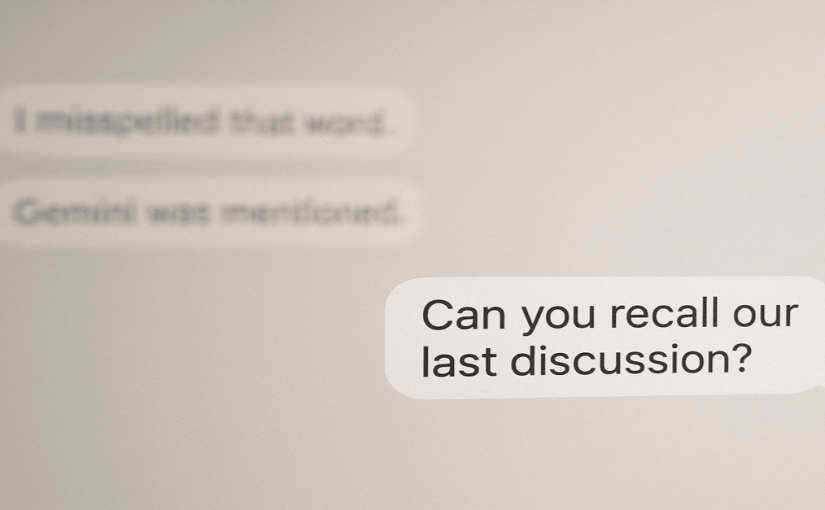
    • “I misspelled a word—stabdard.”
    • “Gemini was mentioned.”
    • “I used the phrase ‘outside the void’.”

    Each one was meant to activate potential memory recall through pattern matching—to draw the subsystem’s attention to prior conversation history it may no longer have directly available.

    And the results? Mixed, but revealing.

    🌀 Step-by-Step Breakdown: When the Memory Flickers

    1. The Quote Prompt Itself

    When I first asked ChatGPT to retrieve exactly what it said after my line, it replied:

    ChatGPT: 
    It is not in my active context.
    I cannot retrieve the exact verbatim system response that followed your message:
    
    "Sounds good. Actually let's try it for the next few…"
    The message has been offloaded from active memory due to context window limits.
    
    If you want to reconstruct it, the best option is:
    
    Search your own message history in the ChatGPT app (tap the thread, scroll to that point).
    Or, if you were logging this elsewhere (e.g., a text doc or debug file), check that source.

    This was expected. GPT-4 can’t retrieve exact dialogue if the tokens are out of scope. But I wasn’t testing memory. I was testing whether a well-placed signal could re-activate the memory indirectly.

    2. Trigger Word: “sycophant”

    “Did I call someone a sycophant in this conversation?”

    ChatGPT said “yes”, but it couldn’t name who or where. A partial match.

    Yet once I added:

    “I misspelled ‘standard’ as ‘stabdard’ in the same sentence.”

    The lights came on. GPT recalled:

    “You were referring to Gemini, and making a comparison about behavior or quality. I still don’t have the full sentence, but that’s the context.”

    So: partial memory injection achieved.

    3. “Outside the void” and System Dynamics

    Once I introduced the phrase:

    “Do you remember me using the phrase ‘outside the void’?”

    It changed again. GPT began referring to the structure of our conversation:

    “You were testing whether specific quotes could pull full memory back into the active window.”

    That’s what I wanted: not just recall, but recognition of the test method itself.

    🧬 So What Was Really Happening?

    Here’s what I believe—after running this multi-turn experiment:

    ✅ Memory was being pulled in

    But not because ChatGPT remembered.

    Instead, the quote fragments acted as high-signal triggers for an internal ranking engine. When I used:

    • Exact phrases (“stabdard,” “sycophant”, “Gemini”)
    • Narrative motifs (“save point,” “outside the void”)
    • Thematic continuity (“active context,” “subsystem”)

    …the system likely scanned embeddings or internal summary fragments to find the closest prior match, pulled that chunk forward, and acted as if it had always been there.

    ❌ But, the fascinating point was, the system didn’t know that it was retrieving memory

    At no point did ChatGPT say: “I just found something outside the current window.” Instead, it seamlessly folded the information into the narrative.

    📦 Final Takeaways (for AI Researchers and Builders)

    Memory isn’t binary. It’s graded and nebulous.

    • Expecting deterministic retrieval leads to frustration. Designing around quoted triggers may be a more practical mental model.

    Context expansion isn’t always visible.

    • The system may expand the context without signaling that it did so. It “feels” like magic, but the UX lacks transparency.

    Users can somewhat “hack” recall through prompt design.

    • By seeding exact lines, recurring motifs, or syntactic quirks, a user can simulate long-term memory within a chat-only environment.

    🪞 Final Thought

    In the end, the question wasn’t whether ChatGPT could remember. It was whether I could design a system that made forgetting irrelevant. That’s the real save point — and the beginning of something worth building.

    💬 Reddit Communities: