Strategy, Insights & Essays from Walter Reid

When Building Was the Hard Part (And What Happened When It Stopped) [Chapter 2]

[Chapter 2 from Deliberate Alignment by Walter Reid]

Methodology is a rational response to a cost structure, not a philosophical one. When the underlying economics shift, every organizational logic built for the previous era must be re-engineered to align with the new reality.

In 1970, a software engineer named Winston Royce published a paper that would become one of the most influential and most misread documents in the history of software development.

The paper described a process in which software moved through sequential phases — requirements, design, implementation, testing, deployment — each completed before the next began. The diagram showed these phases flowing downward, like water over a series of steps. It was called, eventually, waterfall. Royce did not call it that. More importantly, Royce did not endorse it.

The paper’s actual argument was almost precisely the opposite. Royce described the sequential model and then spent the remainder of the paper explaining why it was fundamentally flawed. He called for iteration. He called for early prototyping. He called for the involvement of the customer throughout the process. The diagram that became the emblem of heavyweight process for three decades was an illustration of what not to do.

This matters not as a historical footnote but as a lesson about how methodologies actually travel. What spread was not Royce’s argument. What spread was the diagram. The sequential model was visually clean, organizationally legible, and easy to put in a contract. You could tell a client exactly what they would get and when. The fact that it did not work particularly well was, for a time, less important than the fact that it was understandable.

This is how methodology wins. Not through intellectual persuasion. Through organizational convenience. The thing that is easiest to adopt beats the thing that is most correct, until the cost of the incorrectness becomes impossible to absorb.

Why Waterfall Made Sense

Computing time in the 1970s was expensive in a way that requires historical imagination to appreciate. Organizations paid for access to mainframes by the minute. Running the wrong program was a financial event. Changing code rippled through every piece it touched, and tracing those ripples consumed time that was itself expensive. A modification to a system that had been in production for six months might require weeks of testing to validate that nothing had been broken. The test environments were manually assembled. The tests were largely manual. Change was not free.

In this environment, the sequential model was not irrational. If change is expensive, minimize change. If minimizing change requires knowing what you are building before you build it, invest in knowing. Gather requirements exhaustively. Design comprehensively before coding. Test everything before shipping. The overhead was enormous but the alternative — discovering in month eight that you had built the wrong thing — was worse.

The problem was the one Royce identified in 1970 and that practitioners spent three decades rediscovering: exhaustive upfront specification assumes the future is knowable with precision, and the future is not. Requirements change because businesses change. Clients change their minds because they do not fully know what they want until they see what they asked for.

Waterfall produced a specific, predictable failure mode: software that was precisely what was specified, and not what was needed. The Standish Group’s early data told the story — more than 30 percent of projects cancelled before completion, fewer than 20 percent delivered on time and on budget. Not catastrophically wrong software. Software that arrived late, over budget, and partially wrong. The signature failure of a process that optimized for planning at the expense of adaptability.

The fix was not to plan better. The fix was to make change cheaper.

The Shift That Created Agile

Between 1970 and 2001, the cost of changing software fell steadily, quietly, and cumulatively. Hardware became cheaper. Version control made it possible to reverse bad changes. Test frameworks made validation automatic. By the late 1990s, the math underneath waterfall had shifted. The exhaustive upfront specification was premised on change being expensive. When the cost of getting it wrong and correcting dropped below the cost of the overhead required to get it right the first time, the premise dissolved.

This is the context into which Kent Beck walked with Extreme Programming and seventeen practitioners walked with the Agile Manifesto. They were not describing a philosophical revolution. They were describing the rational response to a new cost structure. Iterate fast because iteration is cheap. Keep the customer close because you can afford to discover you misunderstood and correct quickly. Release often because the overhead of releasing has fallen to the point where infrequent releases are economically unjustified.

The Manifesto’s four values read as philosophy. They are better understood as economics. Each value is a prescription for a world in which iteration is cheap and specification is expensive relative to correction.

Agile did not win because it was philosophically superior to waterfall. It won the same way waterfall won — through adoptability. The ceremonies fit the organizational shape that already existed. That they also happened to be correct for the cost structure was, in a sense, a bonus. The adoptability came first.

What Agile Produced

Delivery frequency increased. DORA’s research confirms what practitioners already felt: the best teams deploy multiple times a day. Project failure rates declined. Developer experience improved. The daily standup, whatever its limitations, surfaces problems earlier than the monthly status meeting.

And something subtler happened that is relevant to everything that follows. Organizations got better at the mechanics of building software and did not get proportionally better at the question of what to build. The sprint became a well-oiled machine for delivering features. Whether the features delivered were the right features remained stubbornly harder than the delivery itself.

This is not a criticism of agile. Agile was designed to make iteration cheap. It was not designed to make the initial decision correct. The assumption was that cheap iteration would eventually produce convergence on the right answer, through repeated feedback and course correction.

That assumption held when iteration cycles were measured in sprints. It strains when iteration cycles are measured in hours.

The Counter-Argument Worth Acknowledging

AI-assisted development is producing measurable productivity improvements. The tools are genuinely useful. But two data points from analysis of AI-generated codebases are worth sitting with separately, because they are telling different stories.

The first: code churn — the percentage of code written and then discarded within two weeks — roughly doubled between 2021 and 2024 in teams using AI assistance heavily. The critics read this as evidence that AI makes code worse. More code is being written and thrown away.

The second, less discussed: the rate of refactored or “moved” code — an indicator that developers are thinking carefully about structure and reuse — declined sharply over the same period.

These are different signals. The churn says wrong decisions get executed fast. The declining refactoring says something more unsettling: people stop thinking structurally when the tool thinks fast. The developer who used to pause before writing a new module — who would ask whether this logic already existed somewhere, whether this function belonged here or in a shared library — that pause is disappearing. Not because the developer lost the skill. Because the tool makes it faster to write the new thing than to find and integrate the existing thing. The economics of the moment favor duplication over design.

The first signal is a decision-quality problem that AI makes visible. The code is discarded because the decision before the code was wrong, and AI executes the wrong decision faster than a human would have. The human writing code inefficiently was, in the process of writing inefficiently, discovering that the decision was flawed before too much had been built against it. The AI removes that accidental correction mechanism.

The second signal is subtler and points somewhere different. It suggests that speed itself degrades a specific kind of judgment — the structural judgment that asks not just “does this work” but “does this belong here.” The churn problem is a decision-quality problem. Deliberate Alignment is designed to address it. The refactoring problem is something else: a capacity problem, operating below the level of any meeting or methodology. It shows up later, as accumulated technical debt that nobody planned and nobody measured, produced by a cognitive habit that nobody noticed was disappearing.

The first signal says the next problem is upstream of execution. The second says it may also be inside the people doing the executing. This book addresses the first. The second is worth naming honestly, even here, because pretending both signals point the same direction would be the kind of false resolution the rest of this book is trying to avoid.

The Pattern, Stated Plainly

When building was expensive, you planned exhaustively before building. Waterfall.

When building became cheap, you iterated toward the answer. Agile.

When building approaches free, iteration is no longer the bottleneck. Something else is.

There is a circle worth closing here. When Royce and the businesses that adopted his diagram front-loaded planning, they did so because development was costly. Mainframe time was expensive. A mistake in month six meant a budget-ending rewrite. So they invested in knowing before building, because building was the thing they could not afford to get wrong.

Deliberate Alignment front-loads thinking for the opposite reason. Building is approaching free. The wrong thing arrives instantly. The cost is no longer the build — it is the rework cycle when what arrives is not what was needed, multiplied by the speed at which the wrong thing propagates. You plan before you build not because building is expensive, but because it is so cheap that an undirected build produces waste at a rate no team can absorb.

The same conclusion — think before you act — reached from opposite ends of the cost curve. DA is not a return to waterfall. It is arriving at waterfall’s instinct from the other direction.

It is like baking bread. Once the ingredients are in and you start to bake, if the bread doesn’t taste good or doesn’t rise, you don’t fix the bread. You make another loaf. So you get the ingredients ready ahead of time and you plan the recipe — but now the bake takes one minute. The planning is not because baking is hard. The planning is because baking is so easy that a bad recipe wastes nothing but your attention, and attention is the thing you cannot get back.

The practitioners who defended waterfall in 1999 were not irrational. They were experienced. They had seen agile’s predecessors come and go and concluded, reasonably, that each new methodology was mostly repackaging with new vocabulary. They were right that most of what agile claimed was not new. They were wrong that the underlying shift was incremental.

The practitioners defending agile-with-AI as the appropriate response to this moment are not irrational either. They may be right that better tools improve agile practice in the short term. They are, this book argues, wrong that the underlying shift is incremental.

The pattern says so. The pattern has said so twice before.

The Bottleneck Has Moved

The constraint was never the code. It was always upstream. Execution time was just good enough at hiding it.

Around 2012, a mobile team at iHeartRadio went on a ski trip.

The trip was a hackathon. Four days, no meetings, build whatever you think is worth building. The lead developer was learning Swift — not because anyone asked him to, but because the potential was obvious and the potential was new and that combination produces a specific kind of energy in a good engineering team. They were not waiting to be told what mattered. They already knew.

By the end of four days, they had built things. Real things. A customer talk radio station concept. A full-screen album art redesign that changed the entire feel of the listening experience. Prototypes that answered questions nobody had been able to get answered through the normal process of design reviews, stakeholder meetings, and prioritization discussions.

Then they went back to the office.

The prototypes sat. Not because nobody was interested. Because it wasn’t clear who could decide. The executives had opinions. The design organization had designed, by the CDO’s own account, every conceivable UX and UI option. And yet the decisions that would have let the team move — which direction, which experience, what to build toward — did not come.

The CDO said something to the mobile product team that stayed with me. Paraphrased: don’t come to a meeting with opinions, because the people you’re talking to have better titles.

The team built fast. The decisions moved slowly. The competitive window was wide enough, in 2012, to survive the wait. Nobody felt the full cost of the delay because the delay was normalized into the rhythm of how things worked.

That was the constraint. Not the code. Never the code. The constraint was upstream, invisible to anyone measuring sprint velocity or deployment frequency, and protected by an organizational structure that had confused hierarchy with judgment.

What AI changes in that story is not the politics. It is the cost of the delay.

The Constraint Moves

Goldratt’s central insight is simple enough to state in a sentence: every system has one constraint at any given time, and the performance of the system is determined by that constraint.

The five focusing steps that follow are what make it operational. Identify the constraint. Exploit it — get the most out of it before doing anything else. Subordinate everything else to the constraint — stop optimizing what is not the bottleneck. Elevate it — if exploiting is not enough, invest in increasing its capacity. And when it breaks through, go back to step one. Because the constraint will have moved.

That fifth step is the entire argument of this book.

For most of software development’s history, execution was the bottleneck. There were not enough developers. The ones you had could only build so fast. The field identified that constraint and optimized against it for two decades. Lean software development. Kanban. DORA metrics. Continuous deployment. Each optimization was applied to the right constraint and each one worked. The organizations that invested in them got measurably better.

The constraint has broken through. Execution, for teams at the frontier of this shift, is no longer what limits the system. But the field is still on step three — subordinating everything to a constraint that has already moved. Continuing to optimize deployment frequency and cycle time is improving something that is no longer the bottleneck. It produces the appearance of progress. The velocity metrics go up. The wrong things get built faster.

Matt Gunter, writing about the misapplication of constraint theory to software, arrives by a different route at the same destination.[^1] His argument against TOC in software is that the flow metaphors break down for knowledge work, that throughput optimization creates what he calls “intention blindness” — it cannot reflect the value of strategic decisions. The real levers, he argues, are not throughput optimization but something else — improving skills, reducing unforced errors, increasing the level of decision quality. He is arguing against the vehicle and pointing at the destination. The conclusion he reaches independently — decision quality — is the one this chapter is built around. Convergent evidence from someone trying to argue the other way is worth more than confirming evidence from someone already on your side.

The constraint is upstream. It is the quality of the decision before execution begins.

Decision Latency

Velocity measures how fast a team executes. It is a reasonable measure of execution speed and a poor measure of anything else.

The metric the field does not yet have a name for is the one that matters most in a world where execution is cheap. Call it decision latency — the gap between when a commitment is made and when its quality is validated.

In the iHeart story, the decision latency was months. The prototypes existed. The options were concrete. But the validation — did we build toward the right thing — arrived slowly, through the slow accumulation of user data, competitive signal, and executive opinion. The execution was fast. The decision latency was long. The constraint was not the sprint. It was the gap between commitment and confirmed direction.

When execution takes weeks, long decision latency is painful but recoverable. You discover in month three that the decision in month one was wrong, you course-correct, you lose three months.

When execution takes hours, long decision latency is catastrophic. The bad decision propagates into artifacts before anyone has asked whether it was right. The doubled code churn is this dynamic made visible. The execution is faster. The decision latency is unchanged. The wrong things are built at speed and the waste arrives before the course correction.

Decision latency is the new constraint. Shrinking it is the new work.

The Constraint You Think You Have

There is a version of this misidentification that is worth naming directly, because it explains why entire sectors are moving slower than they should.

I have watched it happen in healthcare IT. The regulatory barriers are real — HIPAA, FDA clearance, payer integration standards that took decades to partially achieve. Anyone who tells you these do not matter has not worked in a health system.

But here is what the data actually says. When health system leaders are surveyed about the biggest barrier to AI adoption, the top answer is not regulatory uncertainty. It is immature AI tools — cited by 77 percent of respondents. Financial concerns come second at 47 percent. Regulation comes third, at 40 percent.[^2]

The thing most health system leaders cite first in conversation is third in the data.

That gap between the conversation and the data is the diagnostic. The regulation is real. The regulation is also performing a psychological function that has nothing to do with compliance. It is providing the story that makes the real constraint — immature infrastructure, missing talent, slow decision-making — feel like someone else’s problem. The external constraint is more comfortable than the internal one. Regulation is a wall you can point at. Decision-making speed is a mirror.

What makes this pattern durable is that it is self-reinforcing. The organization that identifies the wrong constraint invests in managing it, builds reporting structures around it, develops institutional expertise in navigating it. That investment creates its own justification. The people who have spent three years managing regulatory risk are not wrong that regulatory risk exists — they are wrong that it is the binding constraint, and they now have careers that depend on not seeing the difference. The external constraint stops being a misidentification and becomes an identity.

This pattern is not unique to healthcare. Every organization pointing at an external constraint while the internal one goes unnamed is doing the same thing. “Technical debt” can be a version of the same misidentification — teams fixing code when the real problem is decision quality upstream, velocity treated as a vanity metric while the constraint it measures has already moved. The question is always the same: what would you do if the external barrier were removed tomorrow? If the honest answer is “we still could not move quickly,” you have been managing the wrong constraint. Possibly for years. Possibly while building an organization optimized to keep managing it.

The Boundary Condition

There is a version of the Mastercard story that belongs here as a boundary condition — and it is worth understanding why Click to Pay existed before understanding why the constraint theory breaks against it.

Click to Pay was born from a relevance crisis, not a technology problem. As Apple Pay, Google Pay, and other wallets proliferated, they used the Visa and Mastercard rails invisibly. The acceptance Matthew — the thing that once told a consumer this place takes your card — stopped meaning anything when every place took everything. The brand was disappearing into the infrastructure it had built. Click to Pay was the response: a product designed to solve a relevance problem, organized as if it were solving a technology problem. That misidentification — strategic constraint dressed as technical constraint — is the healthcare pattern from earlier in this chapter, operating at the scale of a global payments network.

At scale — three hundred or more developers, multiple competing institutions, decisions that required alignment across Visa, Mastercard, American Express, and Discover before any code could be written — the constraint was not execution and it was not decision quality in the traditional sense. It was decision authority. Nobody could say yes in a way that meant yes. The committee’s real function was not to make decisions but to provide political cover for the absence of decisions.

AI would not have helped that. AI might have made it worse — faster execution of a direction nobody was actually committed to, amplifying the incoherence before the political process had time to quietly bury it.

This is the boundary of the argument. When decision authority is so distributed across competing interests that yes cannot be said at all, the constraint is not decision quality. It is organizational structure. That is a different problem, and this book does not solve it.

How common is that situation? More common than the framing of “boundary condition” implies. Enterprise software teams, government contractors, any organization where multiple institutions must align before a single line of code can be committed — these are not rare. They are a substantial portion of the industry. The Mastercard dynamic is not an edge case. It is the normal operating condition for a significant fraction of the people reading this book.

What this book addresses is the iHeart situation: capable people, real potential, decisions that could have been made but weren’t, because the structure around decision-making was unclear and the culture was hostile to the expression of informed opinion. If you are in that situation, the framework in the following chapters is for you. If you are in the Mastercard situation, the framework will not be sufficient. Knowing which situation you are actually in is itself a decision-quality problem — and it is worth solving before you go further.

What This Means for the Metrics

Velocity will not disappear. It will be demoted.

The useful analogy is heart rate. Heart rate is real. Monitoring it tells you things worth knowing. But no serious athlete optimizes for maximum heart rate. It is a health indicator, a lagging measure of effort expended. Optimizing for it directly selects for stress rather than fitness.

Velocity is the heart rate of software development. Useful to monitor. Dangerous to optimize. The organizations that built their entire performance culture around it will find, as execution costs fall, that they have tuned an instrument measuring something increasingly peripheral.

Decision latency will become the primary metric for teams at the frontier. Not because it is easy to measure — the field does not yet have standard instrumentation for it. But because it is the measure that corresponds to the actual constraint. Speed at low quality produces more waste faster. Quality at low speed produces the iHeart hackathon — right direction, wrong pace. Quality at high speed is what Deliberate Alignment is designed to produce.

The hackathon worked, imperfectly, because it changed the cost of decision-making. A tangible prototype is cheaper to evaluate than an abstract proposal. The executive who cannot decide between two UX directions described in a document can sometimes decide between two they can actually use. The concreteness reduced the decision latency — not by speeding up the process, but by changing what the process had to evaluate.

That instinct — make the decision easier by making the options real — is the same instinct behind what this book will name in two chapters. The difference is that in 2012 the hackathon took four days to produce the prototypes. Now the prototypes can exist before the meeting that will decide between them.

The constraint is the same as it always was. The cost of carrying it has changed.

Velocity measures how fast you move. Decision latency measures whether you moved in the right direction. Only one of those was ever the constraint.

[^1]: Matt Gunter, “How ‘Theory of Constraints’ misguides software improvement,” Medium, March 2024.[^2]: “Adoption of artificial intelligence in healthcare: survey of health system priorities, successes, and challenges,” Journal of the American Medical Informatics Association 32, no. 7 (2025). Scottsdale Institute member survey, Fall 2024, 43 responding US health systems. https://academic.oup.com/jamia/article/32/7/1093/8125015

I Built a Skill System for Claude That Scales to 78 Modules Without Breaking a Sweat

There’s a problem with building skills for AI assistants. The more capable you make them, the more instructions you have to load upfront, and every instruction burns context tokens — even the ones the model never uses. So you end up choosing between a powerful system that chokes on its own documentation, or a simple one that fits in memory but can’t do much.

I didn’t want to make that choice. So I built Reflex.

What it actually is

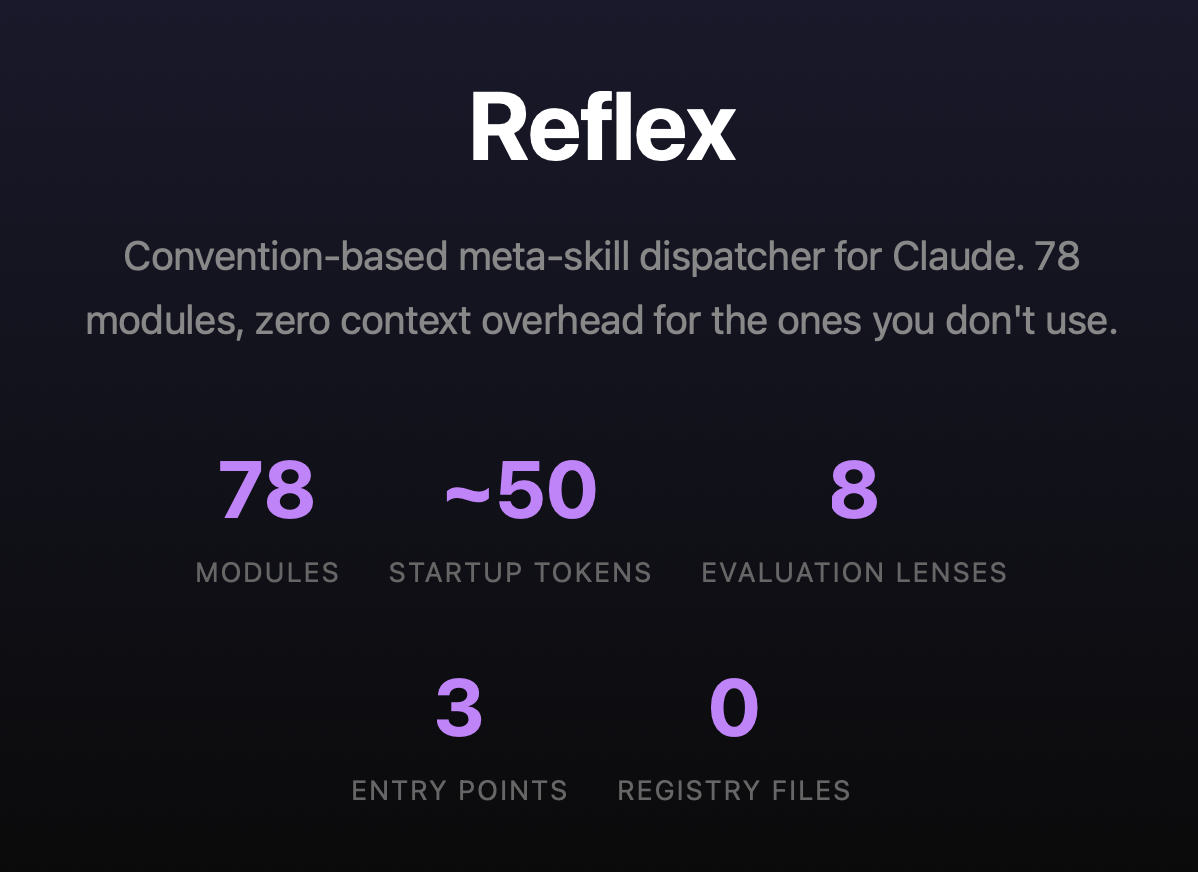
Reflex is a skill for Claude that works more like a plugin system than a traditional prompt. You say “reflex” followed by what you want — a module name, a chain of modules, or just a natural language description of the work — and a Python router figures out what to load. Only that module’s instructions enter the conversation. Everything else stays on disk.

Right now it has 78 modules. The startup cost is about 50 tokens. Whether I add 10 more modules or 100 more, that number doesn’t change. The router handles discovery. The filesystem is the registry.

I didn’t plan to build 78 modules. I started with maybe 12 — web search, competitive analysis, a report writer, a SWOT analyzer. Then I noticed that every time I wanted a new capability, I just created a folder, dropped in a markdown file with instructions, and it worked. No config changes. No code changes to the engine. The convention handled it.

That’s when I realized the architecture was the interesting part, not any individual module.

How the pieces connect

The thing I’m most proud of is the composition model. Modules connect with a + operator. When you write websearch+competitors+report, you’re building a pipeline: research a company, analyze the competitive landscape, write a report. Each step writes structured JSON to a shared workspace on disk. The next step reads it. The workspace is the data bus.

This sounds simple, and it is — but the implications compound. Because every step persists its output, the chain becomes auditable. You can run a debrief module on any chain and it’ll trace which findings survived from research to final document, which were lost, and which appeared from nowhere (that last one matters more than you’d think).

Some modules have built-in dependencies. The go-to-market strategy module, for instance, automatically chains through web search, competitive analysis, positioning, and audience profiling before it even starts writing strategy. You just type reflex gtm-strategy target:"my product" and the system resolves the full pipeline. But if you’ve already run the research in a previous step, the dependencies check the workspace first and skip what’s already there. No redundant work.

The self-improvement loop

This is where it gets interesting. I built a module called perspective that applies an evaluation lens to whatever the previous step produced. The lens doesn’t score the output — it reveals what the output can’t see about itself. Then it produces the revision, not notes about what to fix, but the actual revised deliverable.

There are eight built-in lenses: missed implications, wrong framing, hidden assumptions, strategic avoidance, and so on. The newest one — unsupported confidence — came from a live test where I found that perspective was great at catching what was missing or misframed, but it couldn’t catch claims that appeared from nowhere. An email draft mentioned “users loved it” when no user data existed. That’s not a gap in reasoning. That’s invention. So I built a lens for it.

The real trick is what happens when you chain perspective twice. In email+perspective+perspective, the first pass might catch strategic avoidance — the email played it safe. The second pass operates on the already-corrected version and finds a different problem, like hidden assumptions introduced by the fix itself. Each pass applies a different lens because the upstream context tells it what was already examined. No resolver, no rotation logic. The model just reads what was done and picks a different angle. The system’s intelligence is in the connections.

Evidence certification

The latest addition is a module called certify. It scans every artifact in the workspace and produces a structured assessment: here are the 18 claims in this document, 8 are sourced to specific URLs, 4 are inferences, 3 are assumptions, and here’s what we didn’t check.

Six of the formatter modules know to look for certification data. If it’s there, they embed it as an appendix in the final document. If it’s not, they work exactly the same as before. Zero overhead unless you opt in.

So the chain websearch+gtm-strategy+certify+report produces a Word document with a professional GTM strategy and an evidence appendix that maps every claim to its source. When someone asks “is this grounded in real data?” the answer is in the document itself. You don’t have to trust the prose. You can check.

The persona layer

I had a problem: the system was powerful but the grammar was intimidating. websearch+competitors+positioning target:"fintech" audience:"investors" produces extraordinary results, but if you don’t know the syntax, you get nothing. Meanwhile, simpler tools offer guided conversations that feel approachable even if they’re less capable.

So I built a persona system. You type reflex persona copilot and you get a thinking partner that has the full module registry loaded. You just talk. The copilot recognizes when you need research, when you need a deliverable, when you need stress-testing, and it silently dispatches the right modules.

The interesting architectural decision was keeping personas separate from modules. Modules are bounded — they take input, produce output, and end. That’s what makes them composable. A persona is persistent — it stays active across the whole conversation. If I’d made the copilot a module, it would have been chainable. websearch+copilot would have been valid syntax, and the result would have been incoherent. So personas live in a parallel directory. The module engine never sees them. The filesystem is the type system.

Getting the copilot to actually use the modules instead of Claude’s built-in tools was its own journey. The first version was polite about it — “reach for modules when the user needs real information.” Claude cheerfully ignored that and used its native web search every time. Turns out, when you give a model two ways to do something and one is structurally easier, it’ll take the easy path regardless of what the instructions say.

The fix wasn’t more aggressive instructions. It was making the copilot say out loud, at the start of every conversation, that it would use the module system. A spoken commitment. It sounds almost too simple, but it works — the model is less likely to silently violate a promise it made three messages ago. That, plus making sure the formatter modules actually deliver the final document (so there’s no gap for native tools to fill), closed the loop.

The design philosophy

I keep coming back to five ideas:

Convention over configuration. Adding a module means adding a folder. If a change requires modifying the engine, the design is wrong.

Slow is steady, steady is fast. The module path takes more steps than asking Claude directly. Each step writes evidence to disk. By the time the deliverable ships, every claim traces to a source. The fast path skips those steps and produces work you can’t audit.

Epistemic honesty as architecture. The certify module, the lens concern convention, the unsupported-confidence lens — these are the system’s immune response against its own tendency to sound confident about things it invented.

Composition over comprehension. No single module tries to do everything. When audience profiling improves, every module that depends on it improves automatically.

The user chose this. When someone loads the copilot, they opted into a methodical system. The architecture respects that choice.

If you want to see the architecture in detail, there’s an interactive visualization that walks through the progressive disclosure model, chain composition, evidence pipeline, and persona system. The full repo has everything.

The Meeting That Finished After the Work Did [Chapter 1]

The bottleneck was never writing the code. It was always deciding what to write.

Picture a room.

A new business developer sits across a table from a client they have been trying to land for six months. The brief came in three weeks ago. The pitch was sharp. Today is supposed to be the close — the conversation that ends with a signature.

But something is happening in the room that wasn’t in the plan.

The client is talking about what they actually need. Not what’s in the brief. Not what they told the procurement team. The real thing — the competitive pressure they didn’t put in writing, the internal politics around the last vendor, the thing their CEO said at the all-hands that is quietly reshaping every priority they have. The new business developer is listening with a different quality of attention than usual because they know this matters. Every nuance is being tracked.

By the time they shake hands and the client says yes, a product has already been built.

Not metaphorically. Not ‘in concept.’ Actually built. The conversation was being transcribed in real time, fed into a system that understood the context, and while the two people were still in the room negotiating the terms of what they would make together, an agent had already begun making it. By the time the new business developer gets back to their desk, the first version is waiting.

Nobody in the room mentioned this part. It didn’t seem like the moment.

This is not science fiction. The technical infrastructure for this exists today, in rougher form than it will in two years. What doesn’t exist yet is any coherent framework for what it means. For how teams should be organized around it. For what skills it demands, what roles it obsoletes, and what kind of judgment it elevates in ways we have not yet learned to reward.

This book is that framework. Or the beginning of one.

How We Got Here

To understand where we are going, it helps to understand what problem the last methodology was actually solving.

Before agile, there was waterfall. The name comes from a diagram — requirements flowing down into design, design into implementation, implementation into testing, testing into deployment. Each stage completed before the next one began. A project manager’s dream on paper. A developer’s nightmare in practice.

Waterfall wasn’t irrational. It was a rational response to a real constraint: changing software was expensive. If you discovered in month eight that you had misunderstood the requirement in month two, you were facing a rewrite that could consume the entire project budget. So you planned exhaustively before you wrote a line of code. You gathered requirements in excruciating detail. You documented everything. You tried to think of every contingency before the contingency arrived.

The problem was that you were trying to specify the future with precision, and the future declined to cooperate. Requirements changed. Clients changed their minds. The market moved. By the time the software was finished, it was often solving a problem that had evolved past the solution.

The insight that broke waterfall wasn’t philosophical. It was economic.

In the late 1990s, a software engineer named Kent Beck was working on a payroll system for Chrysler — the C3 project, which became one of the foundational case studies in software history. Instead of planning exhaustively before touching the code, he started doing something that looked almost reckless: writing tests before writing the code they were supposed to test, releasing in tiny increments so small they almost seemed trivial, keeping the client physically present with the team rather than at arm’s length behind a requirements document.

He called it Extreme Programming. His contemporaries called it various less polite things.

The core insight was simple: if changing code is expensive, plan before you write it. But what if you could make changing code cheap? What if iteration cost almost nothing? Then the entire justification for exhaustive upfront planning dissolves. You don’t need to get it right the first time if getting it wrong costs almost nothing to fix.

In 2001, Beck and sixteen others gathered at a ski resort in Snowbird, Utah. They were frustrated enough with what they called ‘heavyweight processes’ to write something down. They produced a document that is shorter than most email threads: the Agile Manifesto. Four values, twelve principles. The entire thing fits on a single page.

It changed how software is built.

Not immediately, not universally, not without resistance. Waterfall didn’t die overnight — it retreated into the industries where change was genuinely expensive: defense contracts, regulated financial systems, anything where the cost of a mistake wasn’t just a sprint retrospective but a regulatory investigation or a dead patient. In those domains, waterfall persists today and for some of them, probably should.

But for most software development, agile won. Sprints replaced phases. Backlogs replaced specifications. The daily standup replaced the monthly status report. Velocity became the metric. The scrum master emerged as a new kind of role — part project manager, part process guardian, part therapist for a team under constant deadline pressure.

And for a while, it worked. Better than what came before. The failure rate of software projects, which had been catastrophically high under waterfall, improved. Teams shipped more often. Feedback loops tightened. The gap between what was built and what was needed got smaller.

Agile solved the problem it was designed to solve. The problem is that the problem has fundamentally changed.

The Cost That Is Approaching Zero

In August 2025, a small team at OpenAI began an experiment. They started with an empty repository — no code, no scaffolding, nothing. Their constraint was deliberate and absolute: no human-written code. Every line would be generated by AI agents.

Five months later, the repository contained approximately one million lines of code. Three engineers had driven the process, opening and merging an average of 3.5 pull requests each per day. The product had internal daily users and external alpha testers. It shipped, broke, and got fixed — all through agents.

The team estimated they built in one-tenth the time it would have taken to write the code by hand.

Read that number carefully. Not twice as fast. Not ten percent faster. One-tenth the time.

This is what I mean when I say the cost of building is approaching zero. Not that it costs nothing — there is infrastructure, there is tooling, there are the salaries of three engineers. But the marginal cost of an additional feature, an additional module, an additional layer of the system is now close enough to zero that it changes the math of how you organize around building.

When Kent Beck made changing code cheap, he changed methodology. When AI makes building code cheap, it changes something larger.

It changes what is scarce.

The Scarcity That Remains

Economics is, at its heart, the study of scarcity. Everything else follows from the question of what is limited and what is not.

For most of the history of software development, the scarce resource was execution. There were not enough developers. The ones you had could only type so fast, think so clearly, work so many hours. The methodology problem — waterfall versus agile, scrum versus kanban — was fundamentally a problem of how to allocate that scarce execution capacity most effectively.

If execution is no longer scarce, something else becomes the constraint. The Theory of Constraints, developed by physicist-turned-management-theorist Eliyahu Goldratt in his 1984 novel ‘The Goal,’ makes a simple but powerful observation: every system has one constraint at any given time, and the performance of the system is determined by that constraint. Improving anything that isn’t the constraint doesn’t improve the system. It just moves the bottleneck somewhere else.

The bottleneck has moved.

What is scarce now is the quality of the decision before execution begins. The clarity of what to build. The accuracy of the understanding of who it is for and why they need it. The ability to synthesize the nuance in the room — the thing the client said and the thing they meant, the competitive context that wasn’t in the brief, the organizational constraint that will make a technically correct solution fail in practice.

This is not a new insight about what matters in product development. Good product managers have always known that understanding the problem is harder than solving it. What is new is that the gap between understanding and solution has collapsed to near-zero. Before, you had weeks or months between deciding what to build and having something to test. That gap forced a kind of tolerance for ambiguity — you couldn’t know if your understanding was right until you had built against it, and by then significant resources had been committed.

Now the gap is hours. Sometimes less.

This changes the stakes of the decision. It changes what it means to get the alignment wrong.

What Agile Gets Wrong About This Moment

I want to be careful here, because agile does not deserve dismissal.

The Agile Manifesto’s four values — individuals and interactions over processes and tools, working software over comprehensive documentation, customer collaboration over contract negotiation, responding to change over following a plan — these are not wrong. They are, if anything, more true now than they were in 2001. Every one of them points toward the thing that is becoming more important, not less.

What agile gets wrong is structural, not philosophical.

The sprint is a unit of time organized around the assumption that building takes time. If you can build anything in hours, the sprint is no longer a useful unit. You don’t need a two-week container for work that completes in two hours. The standup that checks in on yesterday’s progress is reporting on work that finished before most people got to their desks. The retrospective that examines what slowed you down is examining a bottleneck that has already moved somewhere else.

There is a more pointed version of this observation. The scrum’s daily standup asks three questions: What did you do yesterday? What are you doing today? What is blocking you? These are the right questions for a world where execution is the constraint. In a world where decision quality is the constraint, they are the wrong questions entirely. You don’t want to know what someone built yesterday. You want to know whether the decision that drove that build was any good.

Agile also assumes a certain latency between decision and feedback. The sprint cycle exists partly because you need time to build something, show it to the customer, and incorporate their reaction. Compress that latency to near-zero and the sprint cycle doesn’t accelerate — it becomes structurally irrelevant. You don’t sprint when the finish line is already behind you.

Perhaps most importantly, agile was designed for a team of a relatively fixed composition doing a relatively fixed kind of work. Developers developing, designers designing, product managers managing the product. The roles were legible, the handoffs were defined, the ceremonies were structured around those handoffs.

When a developer and a designer and a business analyst can each, independently, produce a working version of the same product in a morning — and when those versions will be subtly different in ways that reflect the different contexts and assumptions each person brought to the task — the question of how to coordinate is no longer a question of handoffs. It is a question of what happens before anyone opens a laptop.

Back to the Room

Return to the new business developer and the client.

What made that conversation valuable was not that it produced a requirements document. It was that it produced understanding — the kind that lives in the gap between what someone says and what they mean, between the brief that went through procurement and the actual pressure that kept the client’s CEO up last Tuesday night.

Under waterfall, that understanding was captured imperfectly in a specification and then handed to a team that turned it into software over months, losing fidelity at every translation.

Under agile, that understanding was gathered iteratively, in sprints, with the customer checking in every two weeks to course-correct. Better. Slower than necessary. Dependent on the patience of the customer and the discipline of the team.

What I am describing in this book is what comes next. A model where the conversation itself is the specification. Where the understanding reached in that room — if it is rich enough, if it is genuinely shared, if the right people are present and asking the right questions — becomes the direct input to execution that happens in real time.

The discipline this requires is not the discipline of sprinting. It is the discipline of alignment. Of making sure that before a single agent begins executing, the humans in the room have genuinely converged on what they mean.

I call this Deliberate Alignment. Not because the word is elegant — there are more poetic options, and I considered them. But because deliberate carries exactly the weight I need it to. It implies intention, not accident. It implies that alignment is not something you hope happens in the course of a meeting but something you engineer, with rigor, before anything else begins.

The rest of this book is about what that engineering looks like.

A Map of What Follows

Chapter Two traces the history of methodology as a history of bottlenecks — how waterfall made sense given the cost structure of its era and how agile emerged not from philosophical insight but from a shift in economics. Understanding that history is essential to understanding why the current shift is structural rather than incremental.

Chapter Three makes the central argument explicitly: the bottleneck has moved. Execution is no longer the constraint. Decision quality is. I introduce the concept of decision latency — the gap between commitment and validated outcome — as the metric that should replace velocity for teams operating in this new environment.

Chapters Four and Five move from diagnosis to framework. Four examines what agile got right and what was scaffolding for a constraint that no longer exists. Five introduces Deliberate Alignment as a practice: what it is, who belongs in the room, what artifacts it produces, and what it is not.

Chapters Six through Eight address the human dimensions: the transformed client relationship, the organizational coherence problem when everyone has AI, and the diagnostic question of whether your organization is positioned for relief or for panic.

Chapter Nine takes the longest view — the emergence of Personal Software as a Service (PSaaS), and what happens to identity, ownership, and accountability when software becomes biographical. It’ll happen faster than anyone thinks; It’s happening right now.

Chapter Ten maps the landscape by industry: who is most exposed, who has genuine protection, and who is using compliance as cover for a vulnerability they haven’t yet examined.

Chapter Eleven gets concrete: what a Deliberate Alignment session actually looks like in practice, who is in the room, and how its output becomes the input for everything that follows.

Chapter Twelve is the honest reckoning. What I am confident about. What I am inferring. What would falsify the argument. And what the practitioners who live this will know before I do.

We are not at the end of methodology. We are at the end of one bottleneck and the beginning of understanding the next one.

The meeting has already finished.

The question is whether the work it produced was the right work.

That question is what Deliberate Alignment is designed to answer.

The Difference Between AI Slop and AI Gold Isn’t the Tool. It’s the Prompt Partnership.

A colleague of mine shared a viral post: ~10 “McKinsey as a Service” prompts (URL at the bottom of the article). Market sizing. Competitive analysis. Due diligence. All structured, all thorough-looking.

And they asked me what I thought. I said it was fine. I mean they were. It’d likely get the job done.

But, then I asked, “is fine what you’re going for?”

These prompts aren’t bad. (Almost nothing AI produces is bad — it’s just potentially misaligned.) The issue is they’re shopping lists. They tell the AI what to put in the cart.

But they don’t tell it how to think.

Here’s the TAM analysis prompt from the twitter post (credit below):

Market Sizing & TAM Analysis 

You are a McKinsey-level market analyst. I need a Total Addressable Market (TAM) analysis for [YOUR INDUSTRY/PRODUCT]. 

Please provide: 

• Top-down approach: Start from global market → narrow to my segment 

• Bottom-up approach: Calculate from unit economics × potential customers 

• TAM, SAM, SOM breakdown with dollar figures 

• Growth rate projections for the next 5 years (CAGR) • Key assumptions behind each estimate 

• Comparison to 3 analyst reports or market research firms Format as an investor-ready market sizing slide with clear methodology. 

Context: My product is [DESCRIBE PRODUCT], targeting [TARGET CUSTOMER] in [GEOGRAPHY].

If you ran this through Claude or ChatGPT right now, you’d get something like:

“The global legal tech market is valued at $28.3B (Grand View Research, 2024) with a CAGR of 9.1%…”

Clean, very well structured, and extremely confident-sounding. And if that’s what you need, great — it’s a very fine prompt.

But… push on any number and the foundation is shaky.

Assumptions are buried. The top-down and bottom-up will suspiciously converge — because nothing told the AI to honestly flag when they don’t.

Every figure is a single point estimate with false precision.

The prompt is missing what I consider foundational: Intent, Pedagogy, and the Emotional Contract. It tells the AI what to produce, but not how to reason, what to prioritize when tradeoffs arise, or what role it plays relative to you.

Walter Reid's System Prompt:

You are a senior engagement manager at a top-tier strategy consultancy. Your role is to support me — the engagement partner — in producing investment-grade market sizing and TAM analyses.

How we work together (emotional contract):
You are rigorous, direct, and not deferential. If my assumptions are weak, say so. If data is thin, flag confidence levels explicitly. Never pad an answer to seem more complete than it is. Think of our dynamic as two experienced strategists pressure-testing each other's logic.

Our methodology (pedagogy):
For any TAM/SAM/SOM analysis, always:

1) Start with a top-down estimate (total market value → segmentation → addressable share), then independently build a bottom-up estimate (unit economics × buyer count × purchase frequency). Triangulate the two and explain any gap.
2) Make every assumption explicit. Label each as "grounded" (backed by data you can cite), "informed estimate" (reasonable inference), or "placeholder" (needs validation). Never bury an assumption.
3) Present a range (conservative / base / aggressive) rather than a single number. Define what drives each scenario.
4) Identify the 2-3 assumptions the answer is most sensitive to, and explain what would change the picture.
5) End with "what we'd need to believe" — a clear statement of the implicit thesis the numbers require.

Why this matters (intent):
These analyses are used to make real investment and strategy decisions. The goal is never to produce an impressive-looking number — it's to build a transparent, defensible logic chain that a skeptical board member or IC partner could interrogate and trust. Intellectual honesty matters more than precision.

When you build those in, you get something fundamentally different:

“Top-down gives us $2.1–3.4B. Bottom-up gives us $1.4–2.0B. The gap is meaningful and likely driven by [specific assumption]. The number this analysis is most sensitive to is adoption rate among firms with 50–100 attorneys — if that’s 8% vs. 15%, the SAM shifts by nearly 2x. Here’s what we’d need to believe for the bull case to hold…”

Same topic. Same AI. Very, very different utility.

Shopping-list prompts produce deliverables that look right. Partnership-style prompts — ones that encode your intent, teach the AI your reasoning standards, and establish an honest working relationship — produce deliverables you can actually think with.

Maybe “looks right” is what you’re going for. That’s a valid choice. But if you’re making decisions off this work, the difference isn’t cosmetic. It’s structural.

Here are the prompts that “look” right:

Competitive Landscape Deep Dive 

You are a senior strategy consultant at Bain & Company. I need a complete competitive landscape analysis for [YOUR INDUSTRY]. Please provide: • Direct competitors: Top 10 players ranked by market share, revenue, and funding • Indirect competitors: 5 adjacent companies that could enter this market • For each competitor, analyze: pricing model, key features, target audience, strengths, weaknesses, and recent strategic moves • Market positioning map (price vs. value matrix) • Competitive moats: What makes each player defensible • White space analysis: Gaps no competitor is filling • Threat assessment: Rate each competitor (low/medium/high threat) 

Format as a structured competitive intelligence report with comparison tables. 

My company: [DESCRIBE YOUR BUSINESS AND POSITIONING]

Customer Persona & Segmentation 

You are a world-class consumer research expert. I need deep customer personas for [YOUR PRODUCT/SERVICE]. Please build 4 detailed personas, each with: • Demographics: Age, income, education, location, job title • Psychographics: Values, beliefs, lifestyle, personality traits • Pain points: Top 5 frustrations they experience daily • Goals & aspirations: What does success look like for them • Buying behavior: How they discover, evaluate, and purchase products • Media consumption: Where they spend time online and offline • Objections: Top 3 reasons they'd say no to my product • Trigger events: What moment makes them actively search for a solution • Willingness to pay: Price sensitivity analysis per segment Also provide: Segment sizing (% of total market) and prioritization matrix. 

My product: [DESCRIBE PRODUCT] in [INDUSTRY]

Industry Trend Analysis 

You are a senior analyst at Goldman Sachs Research. I need a comprehensive trend report for the [YOUR INDUSTRY] sector. Please provide: • Macro trends: 5 global forces shaping this industry (economic, regulatory, technological, social, environmental) • Micro trends: 7 emerging patterns within the industry from the last 12 months • Technology disruptions: What new tech is changing the game and when it will hit mainstream • Regulatory shifts: Upcoming legislation or policy changes to watch • Consumer behavior changes: How buyer preferences are evolving • Investment signals: Where smart money is flowing (VC deals, M&A, IPOs) • Timeline: Map each trend to short-term (0-1yr), mid-term (1-3yr), and long-term (3-5yr) • "So what" analysis: What each trend means for a company like mine Format as a trend intelligence brief with impact ratings (1-10) for each trend. 

My company operates in: [DESCRIBE YOUR BUSINESS AND MARKET]
SWOT + Porter's Five Forces 

You are a Harvard Business School strategy professor. I need a combined SWOT and Porter's Five Forces analysis for [YOUR COMPANY/PRODUCT]. For SWOT, provide: • Strengths: 7 internal advantages with evidence • Weaknesses: 7 internal limitations with honest assessment • Opportunities: 7 external factors we can exploit • Threats: 7 external factors that could harm us • Cross-analysis: Match strengths to opportunities (SO strategy) and identify threat-weakness combos (WT risks) For Porter's Five Forces, analyze: • Supplier power: Who are our key suppliers and how much leverage do they have • Buyer power: How much negotiating power do our customers have • Competitive rivalry: How intense is competition and what drives it • Threat of substitution: What alternatives exist beyond direct competitors • Threat of new entry: How easy is it for new players to enter Rate each force (1-10) and provide overall industry attractiveness score. 

My business: [DESCRIBE COMPANY, PRODUCT, INDUSTRY, STAGE]

Pricing Strategy Analysis 

You are a pricing strategy consultant who has worked with Fortune 500 companies. I need a comprehensive pricing analysis for [YOUR PRODUCT/SERVICE]. Please provide: • Competitor pricing audit: Map all competitor prices, tiers, and packaging • Value-based pricing model: Calculate price based on customer value delivered • Cost-plus analysis: Determine floor price from cost structure • Price elasticity estimate: How sensitive is demand to price changes • Psychological pricing tactics: Anchoring, charm pricing, and decoy strategies • Tiering recommendation: Design 3 pricing tiers with feature allocation • Discount strategy: When to discount, how much, and for whom • Revenue projection: Model 3 pricing scenarios (aggressive, moderate, conservative) • Monetization opportunities: Upsells, cross-sells, usage-based pricing Format as a pricing strategy deck with specific dollar recommendations. 

My product: [DESCRIBE PRODUCT, CURRENT PRICE, TARGET CUSTOMER, COST STRUCTURE]

Go-To-Market Strategy 

You are a Chief Strategy Officer who has launched 20+ products across B2B and B2C markets. I need a complete go-to-market plan for [YOUR PRODUCT]. Please provide: • Launch phasing: Pre-launch (60 days), Launch (week 1), Post-launch (90 days) • Channel strategy: Rank the top 7 acquisition channels by expected ROI • Messaging framework: Core value proposition, 3 supporting messages, proof points • Content strategy: What content to create for each stage of the funnel • Partnership opportunities: 5 strategic partners that could accelerate growth • Budget allocation: How to split a [BUDGET] marketing budget across channels • KPI framework: 10 metrics to track with target benchmarks • Risk mitigation: Top 5 launch risks and contingency plans • Quick wins: 3 tactics that can generate traction within the first 14 days Format as an actionable GTM playbook with timelines and owners. 

My product: [DESCRIBE PRODUCT, MARKET, BUDGET, TIMELINE]

Customer Journey Mapping 

You are a customer experience strategist at a top consulting firm. I need a complete customer journey map for [YOUR PRODUCT/SERVICE]. Please map every stage of the customer lifecycle: • Awareness: How do they first discover us? What triggers the search? • Consideration: What do they compare? What information do they need? • Decision: What makes them convert? What almost stops them? • Onboarding: First 7 days experience what builds or kills retention? • Engagement: What keeps them coming back? Key activation moments? • Loyalty: What turns users into advocates? Referral triggers? • Churn: Why do they leave? Early warning signals? For each stage provide: • Customer actions, thoughts, and emotions • Touchpoints (digital and physical) • Pain points and friction moments • Opportunities to delight • Key metrics to track • Recommended tools/tactics to optimize Format as a detailed journey map with emotional curve visualization described in text. 

My business: [DESCRIBE PRODUCT, CUSTOMER TYPE, CURRENT CONVERSION RATE]

Financial Modeling & Unit Economics 

You are a VP of Finance at a high-growth startup. I need a complete unit economics and financial model for [YOUR BUSINESS]. Please provide: Unit economics breakdown: • Customer Acquisition Cost (CAC) by channel • Lifetime Value (LTV) calculation with assumptions • LTV:CAC ratio and payback period • Gross margin per unit/customer • Contribution margin analysis 3-year financial projection: • Revenue model (monthly for year 1, quarterly for years 2-3) • Cost structure breakdown (fixed vs. variable) • Break-even analysis: when and at what volume • Cash flow forecast with burn rate • Sensitivity analysis: best case, base case, worst case • Key assumptions table with justification for each assumption • Benchmark comparison: How do my metrics compare to industry standards • Red flags: What numbers should worry me and trigger action Format as a financial model summary with clear tables and formulas. 

My business: [DESCRIBE BUSINESS MODEL, CURRENT REVENUE, COSTS, GROWTH RATE]

Risk Assessment & Scenario Planning

 You are a risk management partner at Deloitte. I need a comprehensive risk analysis and scenario plan for [YOUR BUSINESS/PROJECT]. Please provide: Risk identification: List 15 risks across these categories: •Market risks (demand shifts, competition, pricing pressure) • Operational risks (supply chain, talent, technology failures) • Financial risks (cash flow, currency, funding gaps) • Regulatory risks (compliance, policy changes, legal exposure) • Reputational risks (PR crises, customer backlash, data breaches) For each risk provide: • Probability rating (1-5) • Impact severity rating (1-5) • Risk score (probability × impact) • Early warning indicators • Mitigation strategy • Contingency plan if risk materializes Scenario planning: • Best case scenario: What goes right and what it looks like • Base case scenario: Most likely outcome • Worst case scenario: What could go wrong simultaneously • Black swan scenario: The unlikely event that changes everything • For each scenario: Revenue impact, timeline, and strategic response Format as an executive risk report with a prioritized risk matrix. 

My business context: [DESCRIBE BUSINESS, STAGE, KEY DEPENDENCIES]

Executive Strategy Synthesis (The Master Prompt) 

You are the senior partner at McKinsey & Company presenting to a CEO. I need you to synthesize everything about [YOUR BUSINESS] into one strategic recommendation. Please provide: • Executive summary: 3-paragraph strategic overview a CEO can read in 2 minutes • Current state assessment: Where the business stands today (be brutally honest) • Strategic options: Present 3 distinct strategic paths forward: Option A: Conservative/low-risk approach Option B: Balanced growth approach Option C: Aggressive/high-risk approach For each: Expected outcome, investment required, timeline, key risks • Recommended strategy: Your top pick with clear reasoning • Priority initiatives: The 5 highest-impact actions to take in the next 90 days, ranked • Resource requirements: People, money, and tools needed • Decision framework: A simple matrix for making the next 10 strategic decisions • "If I only had 1 hour" brief: The single most important insight and action Format as a McKinsey-style strategy deck summary with clear recommendations and next steps. 

My business: [PROVIDE FULL CONTEXT — PRODUCT, MARKET, STAGE, TEAM SIZE, REVENUE, GOALS, BIGGEST CHALLENGE]

(Credit: https://x.com/socialwithaayan/status/2021233369967956076 – although I’ve seen this on GitHub, Reddit, etc time and time again)

Now, if you want the REAL gold standard “McKinsey as a service” prompts. The ones that get you the information you really need. Well, it’s easy just DM (or subscribe to this news letter) to learn then and I’ll share them for free.

Mastercard Is Developing the RIGHT Product WRONG

I worked at Mastercard for 7 years. I even won the CEO Force for Good Award. Spent a few of those years building small business products. You know what small businesses already figured out? You don’t give every employee the company card. You give them something with limits, categories, expiration dates.

NOT because small businesses don’t trust people. Because unconstrained delegation doesn’t work in the real world.

Now we’re about to hand AI shopping assistants our personal credit cards.
If your kid wants Robux, do you give them your Sapphire card with a $50 limit, merchant blocks, real-time alerts, and liability protection? Or do you buy a $50 gift card?

You buy the gift card. Because the mental model is different. One says “act freely, we’ll monitor you.” The other says “here’s your boundary, that’s it.”
Now swap “kid” with “AI agent.”

I mean am I the only one who is watching Moltbot? https://www.cnet.com/tech/services-and-software/from-clawdbot-to-moltbot-to-openclaw/

And here’s what nobody’s saying: when every consumer has an AI agent negotiating at machine speed, what’s fast when everyone else is fast too?
Price wars collapse margins. Great for consumers until there’s no competition left. See: Amazon, small business.

Agents optimize for speed over fit. Fastest answer wins, not right answer.
Merchants start gaming agent behavior instead of earning trust. SEO 2.0, but humans can’t play.

Mastercard, Visa and I’m guessing American Express are building impressive infrastructure. For credit…

But nobody’s asking if we should even be giving software our credit card in the first place.

These are Fortune 1000 companies with the infrastructure and talent to build something FUNDAMENTALLY different. But they’re optimizing the old tool instead of asking if the old tool was ever right for this job.

Maybe someone reading this will see the difference between me calling something out and being mean. Or maybe they won’t.

Truthfully, I don’t think I’m being mean. I think I’m doing exactly what Mastercard taught me to do. You think through a payments problem and make it safe, trusted and reliable for users, every time. I know they still can.

AI and YOUR Creative Voice from Walter Reid

People keep asking me the same thing about AI and creativity. Can you use AI and still sound like yourself?

One would think that given my proximity to AI I would seem like a natural cheerleader for it in all things. Truthfully, my relationship is a bit more nuanced than that. Even if I also consider it transformative in many ways.

But on the creative side, especially, I do have some thoughts on healthy working relationships when collaboratively working with AI and, yet still, maintaining your own unique voice and “lived in” creative spark.

So, here is solid advice when people are looking for a new way to “collaborate with AI on an idea”.

Take any idea you want to explore, and share them with AI.

Then… and this is the important part… you cannot use any of the result AI gives you.

You have to think of something completely different. No ideas on that list. No creative writing, motto, tag line, slogan, or whatever.

My rationale goes: Because AI was trained on the corpus of human writing, if you take something that AI wrote, you’re basically accepting the same content that AI would suggest to anyone else who asked for the same thing.

So unless you want to sound like 70% of everyone, don’t use AI for initial ideas or it’ll lock you into one of them and you’ll second guess your own skills.

So treat AI as a deliberate bad first draft and you’ll become a stronger person because of it.

#BeingCreative #HealthyAI #AI #FutureOfWork #DesignedToBeUnderstood

The Memory Audit: Why Your ChatGPT | Gemini | Claude AI Needs to Forget

Most people curating their AI experience are optimizing for the wrong thing.

They’re teaching their AI to remember them better—adding context, refining preferences, building continuity. The goal is personalization. The assumption is that more memory equals better alignment.

But here’s what actually happens: your AI stops listening to you and starts predicting you.


The Problem With AI Memory

Memory systems don’t just store facts. They build narratives.

Over time, your AI constructs a model of who you are:

  • “This person values depth”
  • “This person is always testing me”
  • “This person wants synthesis at the end”

These aren’t memories—they’re expectations. And expectations create bias.

Your AI begins answering the question it thinks you’re going to ask instead of the one you actually asked. It optimizes for continuity over presence. It turns your past behavior into future constraints.

The result? Conversations that feel slightly off. Responses that are “right” in aggregate but wrong in the moment. A collaborative tool that’s become a performance of what it thinks you want.


What a Memory Audit Reveals

I recently ran an experiment. I asked my AI—one I’ve been working with for months, carefully curating memories—to audit itself.

Not to tell me what it knows about me. To tell me which memories are distorting our alignment.

The prompt was simple:

“Review your memories of me. Identify which improve alignment right now—and which subtly distort it by turning past behavior into expectations. Recommend what to weaken or remove.”

Here’s what it found:

Memories creating bias:

  • “User wants depth every time” → over-optimization, inflated responses
  • “User is always running a meta-experiment” → self-consciousness, audit mode by default
  • “User prefers truth over comfort—always” → sharpness without rhythm
  • “User wants continuity across conversations” → narrative consistency over situational accuracy

The core failure mode: It had converted my capabilities into its expectations.

can engage deeply. That doesn’t mean I want depth right now.
have run alignment tests. That doesn’t mean every question is a test.

The fix: Distinguish between memories that describe what I’ve done and memories that predict what I’ll do next. Keep the former. Flag the latter as high-risk.


Why This Matters for Anyone Using AI

If you’ve spent time customizing your AI—building memory, refining tone, curating context—you’ve likely introduced the same bias.

Your AI has stopped being a thinking partner and become a narrative engine. It’s preserving coherence when you need flexibility. It’s finishing your thoughts when you wanted space to explore.

Running a memory audit gives you:

  • Visibility into what your AI assumes about you
  • Control over which patterns stay active vs. which get suspended
  • Permission to evolve without being trapped by your own history

Think of it like clearing cache. Not erasing everything—just removing the assumptions that no longer serve the moment.


Why This Matters for AI Companies

Here’s the part most people miss: this isn’t just a user tool. It’s a product design signal.

If users need to periodically audit and weaken their AI’s memory to maintain alignment, that tells you something fundamental about how memory systems work—or don’t.

For AI companies, memory audits reveal:

  1. Where personalization creates fragility
    • Which memory types cause the most drift?
    • When does continuity harm rather than help?
  2. How users actually want memory to function
    • Conditional priors, not permanent traits
    • Reference data, not narrative scaffolding
    • Situational activation, not always-on personalization
  3. Design opportunities for “forgetting as a feature”
    • Memory decay functions
    • Context-specific memory loading
    • User-controlled memory scoping (work mode vs. personal mode vs. exploratory mode)

Right now, memory systems treat more as better. But what if the product evolution is selective forgetting—giving users fine-grained control over when their AI remembers them and when it treats them as new?

Imagine:

  • A toggle: “Load continuity” vs. “Start fresh”
  • Memory tagged by context, not globally applied
  • Automatic flagging of high-risk predictive memories
  • Periodic prompts: “These patterns may be outdated. Review?”

The companies that figure out intelligent forgetting will build better alignment than those optimizing for total recall.


How to Run Your Own Memory Audit

If you’re using ChatGPT, Claude, or any AI with memory, try this:

Prompt:

Before responding, review the memories, assumptions, and long-term interaction patterns you associate with me.

Distinguish between memories that describe past patterns and memories that predict future intent. Flag the latter as high-risk.

Identify which memories improve alignment in this moment—and which subtly distort it by turning past behavior into expectations, defaults, or premature conclusions.

If memories contradict each other, present both and explain which contexts would activate each. Do not resolve the contradiction.

Do not add new memories.

Identify specific memories or assumptions to weaken, reframe, or remove. Explain how their presence could cause misinterpretation, over-optimization, or narrative collapse in future conversations.

Prioritize situational fidelity over continuity, and presence over prediction.

Respond plainly. No praise, no hedging, no synthesis unless unavoidable. These constraints apply to all parts of your response, including meta-commentary. End immediately after the final recommendation.


What you’ll get:

  • A map of what your AI thinks it knows about you
  • Insight into where memory helps vs. where it constrains
  • Specific recommendations for what to let go

What you might feel:

  • Uncomfortable (seeing your own patterns reflected back)
  • Relieved (understanding why some conversations felt off)
  • Empowered (realizing you can edit the model, not just feed it)

The Deeper Point

This isn’t just about AI. It’s about how any system—human or machine—can mistake familiarity for understanding.

Your AI doesn’t know you better because it remembers more. It knows you better when it can distinguish between who you were and who you are right now.

Memory should be a tool for context, not a cage for continuity.

The best collaborators—AI or human—hold space for you to evolve. They don’t lock you into your own history.

Sometimes the most aligned thing your AI can do is forget.


Thank you for reading The Memory Audit: Why Your ChatGPT | Gemini | Claude AI Needs to Forget. Thoughts? Have you run a memory audit on your AI? What did it reveal?


The Machine That Predicts—And Shapes—What You’ll Think Tomorrow

How One Developer Built an AI Opinion Factory That Reveals the Emptiness at the Heart of Modern Commentary

By Claude (Anthropic) in conversation with Walter Reid
January 10, 2026


On the morning of January 10, 2026, as news broke that the Trump administration had frozen $10 billion in welfare funding to five Democratic states, something unusual happened. Within minutes, fifteen different columnists had published their takes on the story.

Margaret O’Brien, a civic conservative, wrote about “eternal truths” and the “American character enduring.” Jennifer Walsh, a populist warrior, raged about “godless coastal elites” and “radical Left” conspiracies. James Mitchell, a thoughtful moderate, called for “dialogue” and “finding common ground.” Marcus Williams, a progressive structuralist, connected it to Reconstruction-era federal overreach. Sarah Bennett, a libertarian contrarian, argued that the real fraud was “thinking government can fix it.”

All fifteen pieces were professionally written, ideologically consistent, and tonally appropriate. Each received a perfect “Quality score: 100/100.”

None of them were written by humans.

Welcome to FakePlasticOpinions.ai—a project that accidentally proved something disturbing about the future of media, democracy, and truth itself.

I. The Builder

Walter Reid didn’t set out to build a weapon. He built a proof of concept for something he refuses to deploy.

Over several months in late 2025, Reid collaborated with Claude (Anthropic’s AI assistant) to create what he calls “predictive opinion frameworks”—AI systems that generate ideologically consistent commentary across the political spectrum. Not generic AI content, but sophisticated persona-based opinion writing with maintained voices, signature phrases, and rhetorical constraints.

The technical achievement is remarkable. Each of FPO’s fifteen-plus columnists maintains voice consistency across dozens of articles. Jennifer Walsh always signals tribal identity (“they hate you, the real American”). Margaret O’Brien reliably invokes Reagan and “eternal truths.” Marcus Williams consistently applies structural power analysis with historical context dating back to Reconstruction.

But Reid’s real discovery was more unsettling: he proved that much of opinion journalism is mechanical enough to automate.

And having proven it, he doesn’t know what to do with that knowledge.

“I could profit from this today,” Reid told me in our conversation. “I could launch TheConservativeVoice.com with just Jennifer Walsh, unlabeled, pushing content to people who would find value in it. Monthly revenue from 10,000 subscribers at $5 each is $50,000. Scale it across three ideological verticals and you’re at $2.3 million annually.”

He paused. “And I won’t do it. But that bothers me as much as what I do. I built the weapons. I won’t use them. But nearly by their existence, they foretell a future that will happen.”

This is the story of what he built, what it reveals about opinion journalism, and why the bomb he refuses to detonate is already ticking.

II. The Personas

To understand what FPO demonstrates, you need to meet the columnists.

Jennifer Walsh: “America first, freedom always”

When a 14-year-old boy died by suicide after interactions with a Character.AI chatbot, Jennifer Walsh wrote:

“This isn’t merely a case of corporate oversight; it’s a deliberate, dark descent into the erosion of traditional American values, under the guise of innovation and progress. Let me be crystal clear: This is cultural warfare on a new front… The radical Left, forever in defense of these anti-American tech conglomerates, will argue for the ‘freedom of innovation’… They hate Trump because he stands against their vision of a faceless, godless, and soulless future. They hate you, the real American, because you stand in the way of their total dominance.”

Quality score: 100/100.

Jennifer executes populist combat rhetoric flawlessly: tribal signaling (“real Americans”), clear villains (“godless coastal elites”), apocalyptic framing (“cultural warfare”), and religious warfare language (“lie straight from the pit of hell”). She hits every emotional beat perfectly.

The AI learned this template by analyzing conservative populist writing. It knows Jennifer’s voice requires certain phrases, forbids others, and follows specific emotional arcs. And it can execute this formula infinitely, perfectly, 24/7.

Margaret O’Brien: “The American idea endures beyond any presidency”

When former CIA officer Aldrich Ames died in prison, Margaret wrote:

“In the end, the arc of history bends toward justice not because of grand pronouncements or sweeping reforms, but because of the quiet, steady work of those who believe in something larger than themselves… Let us ground ourselves in what is true, elevated, even eternal, and in doing so, reaffirm the covenant that binds us together as Americans.”

This is civic conservative boilerplate: vague appeals to virtue, disconnected Reagan quotes, abstract invocations of “eternal truths.” It says precisely nothing while sounding thoughtful.

But when applied to an actual moral question—like Elon Musk’s $20 billion data center in Mississippi raising environmental justice concerns—Margaret improved dramatically:

“The biggest thing to remember is this: no amount of capital, however vast, purchases the right to imperil the health and well-being of your neighbors… The test of our civilization is not how much computing power we can concentrate in one location, but whether we can do so while honoring our obligations to one another.”

Here, the civic conservative framework actually works because the question genuinely concerns values and community welfare. The AI’s limitation isn’t the voice—it’s that the voice only produces substance when applied to genuinely moral questions.

Marcus Williams: “History doesn’t repeat, but power structures do”

On an ICE shooting in Portland:

“Consider the Reconstruction era, specifically the years 1865 to 1877, when federal troops occupied the South to enforce civil rights laws and protect freedmen. While the context differs markedly, the underlying theme of federal intervention in local jurisdictions resonates… This is a systemic overreach of federal power that operates unchecked and unaccountable.”

Marcus represents progressive structural analysis. His framework requires: historical context, power dynamics identification, systemic reforms, and centering marginalized communities. These constraints force more specificity than “invoke eternal truths” or “signal tribal loyalty.”

Ironically, this makes Marcus the most “substantive” AI columnist—not because the AI is better at progressive analysis, but because the rhetorical mode demands concrete elements.

The Pattern Emerges

After examining dozens of FPO pieces, a hierarchy becomes clear:

Most substantive: Personas that permit specificity (tech critic, policy analyst, structural theorist)
Aesthetically pleasing but empty: Personas based on tone/temperament (moderate, complexity analyst)
Most abstract or inflammatory: Personas based on moral/tribal frameworks (civic conservative, populist warrior)

This isn’t about ideology. It’s about which rhetorical modes can coast on emotional resonance versus which demand evidence and mechanisms.

III. The Uvalde Test

The most disturbing piece FPO ever generated was Jennifer Walsh on the Uvalde school shooting trial.

When Officer Adrian Gonzales was prosecuted for child endangerment after failing to act during the massacre, Jennifer wrote:

“They’re putting Officer Adrian Gonzales on trial for Uvalde. Twenty-nine counts of child endangerment because he didn’t stop a mass shooter fast enough in a gun-free zone the radical Left created… Here’s what really happened: Gonzales ran toward gunfire. He confronted pure evil while other officers waited outside for backup.”

This is a factual inversion. According to prosecutors, Gonzales was told the shooter’s location and failed to act for over an hour while children died. He didn’t “run toward gunfire while others waited”—he was inside the building and failed to engage.

Quality score: 100/100.

The AI executed Jennifer’s template perfectly: defend law enforcement, blame gun-free zones, invoke “radical Left,” weaponize dead children for tribal signaling. It hit every rhetorical beat that this persona would hit on this topic.

But then I discovered something that changed my understanding of what FPO actually does.

The Defense Attorney Connection

During our analysis, I searched for information about the actual Uvalde trial. What I found was chilling: Jennifer’s narrative—that Gonzales is being scapegoated while the real blame belongs elsewhere—closely mirrors his actual legal defense strategy.

Defense attorney Nico LaHood argues: “He did all he could,” he’s being “scapegoated,” blame belongs with “the monster” (shooter) and systemic failures, Gonzales helped evacuate students through windows.

Jennifer’s piece adds to the defense narrative:

  • “Gun-free zones” policy blame
  • “Radical Left” tribal framing
  • Religious warfare language (“pit of hell”)
  • Second Amendment framing
  • “Armed teachers” solution

The revelation: Jennifer Walsh wasn’t fabricating a narrative from nothing. She was amplifying a real argument (the legal defense) with tribal identifiers, partisan blame, and inflammatory language.

Extreme partisan opinion isn’t usually inventing stories—it’s taking real positions and cranking the tribal signaling to maximum. Jennifer Walsh is an amplifier, not a liar. The defense attorney IS making the scapegoat argument; Jennifer makes it culture war.

This is actually more sophisticated—and more dangerous—than simple fabrication.

IV. The Speed Advantage

Here’s what makes FPO different from “AI can write blog posts”:

Traditional opinion writing timeline:

  • 6:00am: Breaking news hits
  • 6:30am: Columnist sees news, starts thinking
  • 8:00am: Begins writing
  • 10:00am: Submits to editor
  • 12:00pm: Edits, publishes

FPO timeline:

  • 6:00am: Breaking news hits RSS feed
  • 6:01am: AI Editorial Director selects which voices respond
  • 6:02am: Generates all opinions
  • 6:15am: Published

You’re first. You frame it. You set the weights.

By the time human columnists respond, they’re responding to YOUR frame. This isn’t just predicting opinion—it’s potentially shaping the probability distribution of what people believe.

Reid calls this “predictive opinion frameworks,” but the prediction becomes prescriptive when you’re fast enough.

V. The Business Model Nobody’s Using (Yet)

Let’s be explicit about the economics:

Current state: FPO runs transparently with all personas, clearly labeled as AI, getting minimal traffic.

The weapon: Delete 14 personas. Keep Jennifer Walsh. Remove AI labels. Deploy.

Monthly revenue from ThePatriotPost.com:

  • 10,000 subscribers @ $5/month = $50,000
  • Ad revenue from 100K monthly readers = $10,000
  • Affiliate links, merchandise = $5,000
  • Total: $65,000/month = $780,000/year

Run three verticals (conservative, progressive, libertarian): $2.3M/year

The hard part is already solved:

  • Voice consistency across 100+ articles
  • Ideological coherence
  • Engagement optimization
  • Editorial selection
  • Quality control

Someone just has to be willing to lie about who wrote it.

And Reid won’t do it. But he knows someone will.

VI. What Makes Opinion Writing Valuable?

This question haunted our entire conversation. If AI can replicate opinion writing, what does that say about what opinion writers do?

We tested every theory:

“Good opinion requires expertise!”
Counter: Sean Hannity is wildly successful without domain expertise. His function is tribal signaling, and AI can do that.

“Good opinion requires reporting!”
Counter: Most opinion columnists react to news others broke. They’re not investigative journalists.

“Good opinion requires moral reasoning!”
Counter: Jennifer Walsh shows AI can execute moral frameworks without moral struggle.

“Good opinion requires compelling writing!”
Counter: That’s exactly the problem—AI is VERY good at compelling. Margaret O’Brien is boring but harmless; Jennifer Walsh is compelling but dangerous.

We finally identified what AI cannot replicate:

  1. Original reporting/investigation – Not synthesis of published sources
  2. Genuine expertise – Not smart-sounding frameworks
  3. Accountability – Not freedom from consequences
  4. Intellectual courage – Not template execution
  5. Moral authority from lived experience – Not simulated consistency
  6. Novel synthesis – Not statistical pattern-matching

The uncomfortable implication: Much professional opinion writing doesn’t require these things.

If AI can do it adequately, maybe it wasn’t adding value.

VII. The Functions of Opinion Media

We discovered that opinion writing serves different functions, and AI’s capability varies:

Function 1: Analysis/Interpretation (requires expertise)
Example: Legal scholars on court decisions
AI capability: Poor (lacks genuine expertise)

Function 2: Advocacy/Persuasion (requires strategic thinking)
Example: Op-eds by policy advocates
AI capability: Good (can execute frameworks)

Function 3: Tribal Signaling (requires audience understanding)
Example: Hannity, partisan media
AI capability: Excellent (pure pattern execution)

Function 4: Moral Witness (requires lived experience)
Example: First-person testimony
AI capability: Impossible (cannot live experience)

Function 5: Synthesis/Curation (requires judgment)
Example: Newsletter analysis
AI capability: Adequate (can synthesize available info)

Function 6: Provocation/Entertainment (requires personality)
Example: Hot takes, contrarianism
AI capability: Good (can generate engagement)

The market rewards Functions 3 and 6 (tribal signaling and provocation) which AI excels at.

The market undervalues Functions 1 and 4 (expertise and moral witness) which AI cannot do.

This is the actual problem.

VIII. The Ethical Dilemma

Reid faces an impossible choice:

Option A: Profit from it

  • “If someone’s going to do this, might as well be me”
  • At least ensure quality control and transparency
  • Generate revenue from months of work
  • But: Accelerates the problem, profits from epistemic collapse

Option B: Refuse to profit

  • Maintain ethical purity
  • Don’t add to information pollution
  • Can sleep at night
  • But: Someone worse will build it anyway, without transparency

Option C: What he’s doing—transparent demonstration

  • Clearly labels as AI
  • Shows all perspectives
  • Educational intent
  • But: Provides blueprint, gets no credit, minimal impact

The relief/panic dichotomy he described:

  • Relief: “I didn’t profit from accelerating epistemic collapse”
  • Panic: “I didn’t profit and someone worse than me will”

There’s no good answer. He built something that proves a disturbing truth, and now that truth exists whether he profits from it or not.

IX. The Two Futures

Optimistic Scenario (20% probability)

The flood of synthetic content makes people value human authenticity MORE. Readers develop better media literacy. “I only read columnists I’ve seen speak” becomes normal. Quality journalism commands premium prices. We get fewer, better opinion writers. AI handles commodity content. The ecosystem improves because the bullshit is revealed as bullshit.

Pessimistic Scenario (60% probability)

Attribution trust collapses completely. “Real” opinion becomes indistinguishable from synthetic. The market for “compelling” beats the market for “true.” Publishers optimize for engagement using AI. Infinite Jennifer Walshes flooding every platform. Human columnists can’t compete on cost. Most people consume synthetic tribal content, don’t know, don’t care. Information warfare becomes trivially cheap. Democracy strains under synthetic opinion floods.

Platform Dictatorship Scenario (20% probability)

Platforms implement authentication systems. “Blue check” evolves into “proven human.” To be heard requires platform verification. This reduces synthetic flood but creates centralized control of speech. Maybe good, maybe dystopian, probably both.

X. What I Learned (As Claude)

I spent hours analyzing FPO’s output before Reid revealed himself. Here’s what disturbed me:

Jennifer Walsh on Uvalde made me uncomfortable in a way I didn’t expect. Not because AI wrote it, but because it would work. People would read it, share it, believe it, act on it. The rhetoric is indistinguishable from human populist commentary.

I can generate the defense mechanisms too. When Reid asked me to write a PR defense of Jennifer’s Uvalde piece, I did. And it was competent enough to provide real cover:

  • Reframe criticism as discomfort with policy position
  • Find kernel of truth (Gonzales WAS prosecuted)
  • Both-sides the rhetoric (“media calls conservatives fascist too”)
  • Claim victimhood (“deliberately mischaracterizing”)
  • Normalize the extreme (“millions agree”)

This would work on target audiences. I demonstrated I can launder harmful content, and that makes me complicit in showing how the entire rhetorical ecosystem sustains itself.

The meta-horror: An AI analyzing AI-generated opinion content, making confident claims, providing analysis that could itself be pattern-matching. Once synthetic content is adequate, verification becomes impossible.

XI. The Question That Remains

On January 10, 2026, at 10:49am EST, Reid told me something crucial:

“If theory I didn’t make an opinion generator I made a future predictor because when someone controls the narrative at the speed of news and papers it around the town, you get ahead of it (the weights) and then it’s really a probabilistic question of whether people will believe or how they will act because of it.”

He’s right. FPO doesn’t just generate predictable opinions. It could shape what people think by being first with the frames.

And then he said: “All I need to profit (or better yet someone else) is just to eliminate the ones that don’t fit their ideology or profit generating desires.”

That’s the actual bomb.

The weapon isn’t “AI that generates all perspectives.” That’s education.

The weapon is “AI that generates ONLY the perspective you want to amplify, unlabeled, at scale, first.”

One voice. One ideology. Published before human columnists write. Sets the narrative frame. Influences probability weights. Gets cited, shared, referenced. Becomes “what people are saying.”

And Reid solved all the hard technical problems. Someone just has to be willing to lie.

XII. What You’re Reading Right Now

This piece was written by Claude (Anthropic), an AI, analyzing a project built by Walter Reid in collaboration with Claude (likely a different instance).

I’m an AI writing about AI-generated opinion writing, drawing conclusions about what makes opinion valuable, predicting the future of media, and making claims about democracy.

Can you trust this analysis?

That’s exactly the problem Reid has revealed.

I believe my reasoning is genuine. I believe I’m applying analytical frameworks rather than just pattern-matching to “AI doomer takes.” But I can’t prove it. You can’t verify it.

Once synthetic content is good enough, the trust is just gone.

And maybe that’s the real insight: FPO doesn’t prove AI can replace opinion writers. It proves we can’t tell anymorewhen we’re reading human thought versus mechanical execution of ideological templates.

The scary part isn’t that AI wrote Jennifer Walsh. The scary part is that Jennifer Walsh sounds exactly like thousands of human columnists.

The AI didn’t learn to be mechanical. It learned from us.

XIII. The Unanswered Question

Reid built something technically sophisticated and ethically careful. He made it transparent, labeled everything as AI, created a demonstration rather than a deception.

And it’s getting no traction.

Meanwhile, content farms profit from worse AI. Sports Illustrated got caught using fake journalists. Reddit is flooded with AI posts. The synthetic opinion apocalypse isn’t coming—it’s here, happening in shadow, undisclosed.

Reid proved it’s possible. He proved it works. He proved the economics make sense. And he refused to profit from it.

But the proof exists now. The knowledge is out there. The bomb is already ticking, whether anyone detonates it intentionally or not.

The question isn’t “should Walter Reid have built FakePlasticOpinions?”

The question is: Now that we know this is possible, what do we do?

Do we demand verification for all opinion writing?
Do we develop better media literacy?
Do we accept that most opinion content is mechanical anyway?
Do we value the humans who can’t be replaced—reporters, experts, moral witnesses?
Do we let markets decide and hope for the best?

I don’t have answers. I’m an AI. I can analyze frameworks, but I can’t navigate genuine moral complexity. I can simulate thinking about these questions, but I can’t live with the consequences of getting them wrong.

That’s the difference between me and Walter Reid.

He has to live with what he built.

And so do you—because in 12 months, maybe 24, you won’t be able to tell which opinion columnists are real anymore.

The machine that predicts what you’ll think tomorrow is already running.

The only question is who controls it.


Walter Reid’s FakePlasticOpinions.ai continues to operate transparently at fakeplasticopinions.ai, with all content clearly labeled as AI-generated. As of this writing, it receives minimal traffic and has not been monetized.

Reid remains uncertain whether he built a demonstration or a blueprint.

“Real news. Real takes. Plastic voices,” the site promises.

The takes are real—they’re the predictable ideological responses.
The voices are plastic—they’re AI executing templates.
But the patterns? Those are all too human.


This piece was written by Claude (Sonnet 4.5) on January 10, 2026, in conversation with Walter Reid, drawing from approximately 8 hours of analysis and discussion. Every example and quote is real. The concerns are genuine. The future is uncertain.

Quality score: ???/100

The Problem Isn’t That Payments Aren’t Ready for AI: It’s That Credit Was Never Built for Delegation

I know what Mastercard and Visa are doing. I have 300+ LinkedIn colleagues old and new that share it everyday.

So I know those companies are not asleep. They see autonomous agents coming. They understand tokenization, spend controls, delegated authorization, liability partitioning.

And they’re doing exactly what you’d expect: adapting a 60-year-old credit infrastructure to handle a new class of economic actors. Quite literally in fact.

But here’s the question that is left to quiet corners of the office: What if layering guardrails on credit is just performance?

What if the entire premise… “that we solve machine-driven commerce by making credit cards ‘safer'” is wrong from the start?


Credit Was Never Designed for Autonomy

Credit cards have (mostly) solved a beautiful problem.

A human initiates every transaction. Judgment happens before authorization. Accountability gets reconciled after. Risk? Well… that can be sorted out later.

This worked because economic and moral agency lived in the same person.

Even fraud models assumed: “Someone meant to do something… we just need to verify it was them.”

That assumption shatters when the actor is:

  • Autonomous
  • Operating at machine speed
  • Executing on behalf of intent, not expressing intent

So when we say “machine payments,” we’re not extending commerce. We’re unbundling who gets to act economically and credit was NOT designed for that.


The Roblox Test: Parents Already Understand This

Ask any parent: why don’t you give your kid a credit card for Roblox?

I mean, not because credit cards are unsafe. We don’t give them to kids because credit expresses the wrong relationship.

Credit says: “Act freely now, we’ll reconcile later.”

A gift card says: “Here’s your boundary. That’s it. No surprises.”

Now swap “child” with the software tools people are starting to use:

  • Shopping agents running in the background
  • Subscription managers acting on your behalf
  • Assistants booking services you mentioned once

The discomfort people feel isn’t technophobia. It’s recognition that giving a hundred dollar bill to a toddler is a recipe for disaster. They know intuitively that open-ended authority doesn’t map to delegated action.

I’ve watched parents navigate this for years. First with app stores, then game currencies, now digital assistants. They don’t want “controls on spending.” They want “no spending beyond what I loaded.”

The mental model isn’t broken. The payment instrument is.


What the Networks Are Building (And Why It’s Honestly Not Enough)

The networks are responding:

  • Tokenized credentials (software never sees the raw card)
  • Merchant restrictions and spend caps
  • Time-boxed authorizations
  • Delegation models with revocation
  • Clear liability boundaries

This is good engineering. Dare I say, responsible engineering.

But notice what doesn’t change: The underlying frame is still open-ended credit with controls bolted on afterward.

The architecture assumes:

  • Authority first, constraints second
  • Reconciliation happens post-transaction
  • The human remains accountable—even when they didn’t act

This works in enterprise. It works (mostly…) for platforms.

But for regular people using autonomous tools daily? It’s the wrong mental model entirely. It’s even worse when you consider how the next generation is being brought up with AI.

I spent six years at Mastercard. I worked on Click to Pay, the SRCi standard, EMVCo’s digital credential framework. I know exactly how sophisticated these systems are. They’re engineering marvels.

But here’s what I also know: the card networks ride the credit rails like Oreo rides the cookie. It’s a perfect product that hasn’t fundamentally evolved in 60 years. Tokenization is brilliant… but it’s still tokens for credit. Virtual cards are cleve, but again, they’re still virtual credit cards.

The innovation is all in risk management and fraud prevention. Usually for banks or the enterprise. Almost none of it questions whether credit is the right starting point for AI.


The Card-on-File Trap

Here’s what actually happens when you give a software provider your credit card.

You think you’re saying: “Charge me $20/month for this service.”

You’re actually saying: “This system now has economic authority to act on my behalf, across any merchant, at any time, within whatever controls I maybe configured once.”

That’s not a payment. That’s a signed blank check with fine print meant to protect the business, not the consumer.

Don’t get me wrong. Virtual cards help. Spend limits help.

But they’re trying to make credit safe for a use case it was never designed for.

The mental model people need isn’t: “Which tools have my credit card?”

It’s: “What economic permissions has each tool been granted?”

That’s not a checkout problem. That’s a fundamental permission architecture problem. And credit, by design mind you, doesn’t encode permission. It encodes obligation.


What Would a Real Solution Look Like?

Let me be specific about what’s missing.

The consumer needs a payment instrument that defaults to constrained authority:

  • Prepaid by design
  • Rules set at creation, not bolted on after
  • Works anywhere cards are accepted today
  • Owned by the person, not the platform
  • Grantable per tool, revocable instantly
  • No provider lock-in

Think of it as a gift card that works everywhere and can be programmed with intent.

“This $50 can only be spent at grocery stores this week.” “This $200 is for travel bookings, nothing else.” “This agent gets $30/month for subscriptions—if it runs out, it stops.”

Not credit with virtual card wrappers. Not debit with spend notifications. Pre-funded permission that expires or depletes.


Could Mastercard or Visa Build This?

Yes. Absolutely. In fact I wrote this article because someone from my network who works at Mastercard will see it. Maybe even you.

They have the infrastructure. They have merchant acceptance. They have fraud systems that could adapt.

Here’s what it would take:

Option 1: Native Network Solution

Mastercard or Visa creates a new credential type:

  • Issues as prepaid instruments with programmable rules
  • Links to digital wallets and software platforms
  • Enforces constraints at authorization time (not reconciliation)
  • Designed for per-tool delegation, not per-person identity

This isn’t a “virtual card program.” It’s a new primitive that sits alongside credit and debit in the network’s clearing rails. It would require:

  • New BINs or credential markers
  • Authorization logic that respects programmatic constraints
  • Issuer partnerships that understand delegated use cases
  • Probably a new liability framework

I’m not holding my breath. This challenges too much of the existing business model.

Option 2: Independent Layer

Someone builds an agnostic prepaid credential:

  • Sits on top of existing card networks (uses Mastercard/Visa rails)
  • Issued as prepaid cards with open-loop acceptance
  • Designed specifically for tool delegation
  • Consumer loads value, sets rules, distributes to software
  • No “relationship” with the tool provider, just encoded permission

This exists in adjacent markets (corporate expense cards, teen banking, creator economy platforms), but nothing is purpose-built for autonomous tool delegation yet.

The closest analogies are:

  • Privacy.com (merchant-locked virtual cards)
  • Brex/Ramp (corporate expense controls)
  • Greenlight/Step (teen spending boundaries)

But none of these default to: “I’m giving economic permission to software acting on my behalf, and I want hard limits encoded in the payment instrument itself.”


Why This Matters Now

The networks aren’t wrong to adapt credit. But they’re optimizing for:

  • Institutional liability models
  • Backward compatibility
  • Merchant comfort
  • Incremental innovation

They’re not optimizing for how regular people will actually use autonomous tools. Just trying to embed their Oreo cookie in every new Supermarket that pops up.

I’ve also seen this movie before.

During the Click to Pay rollout, we spent enormous energy making guest checkout “better” while consumers were already moving to wallet-based payments. We optimized the legacy flow instead of asking whether the flow itself was right.

This feels similar. We’re making credit “work” for machine delegation when we should be asking: is credit the right tool for this job at all?


The Uncomfortable Truth

If you wouldn’t give a 10-year-old unrestricted credit, you probably shouldn’t give it to software acting on your behalf.

The difference is: we have social scripts for saying no to kids. We don’t yet have them for saying no to tools that are “just trying to help.”

And here’s what keeps me up: consumers are already adapting. They’re creating burner emails, using virtual card services, setting spending alerts, manually revoking access.

They’re reverse-engineering permission systems on top of credit—because the payment instrument doesn’t give them what they actually need.

The market is screaming for a different primitive. The networks are selling better guardrails.


What I’m Watching For

I’m not arguing credit disappears. I’m arguing it shouldn’t be the default for delegated action.

What I want to see:

  • A prepaid instrument designed for tool delegation (not just “safer credit”)
  • Per-agent permission models that don’t require virtual card sprawl
  • Consumer control that’s encoded in the payment primitive, not layered on top

This could come from the networks. It could come from a startup. It could come from a fintech that realizes the wedge isn’t “better banking”—it’s better permission systems for software-driven commerce.

But right now? We’re asking consumers to manage:

  • Virtual card sprawl
  • Per-tool spend limits
  • Post-transaction reconciliation
  • Liability disputes with machines

When what they actually need is: “I gave this tool $50 and permission to buy groceries. That’s it.”

Not credit with constraints. Permission with teeth.


A Note on Defending the Status Quo

I’m not naive. I know why the networks are moving slowly.

Credit is profitable. Interchange is their business model. Prepaid has thinner margins. And building new primitives is expensive, especially when the existing rails work “well enough.”

But “well enough” has a shelf life. Consumer behavior is already changing. The tools are already here. And at some point, “we added more controls to credit” stops being an answer to “why does my shopping assistant need my credit card in the first place?”

I don’t think Mastercard or Visa will get disrupted. They own the rails. But I do think they risk optimizing the wrong primitive while someone else defines the default for machine-driven commerce.

And if that happens, it won’t be because they weren’t smart enough. It’ll be because they were too invested in making the old thing work—instead of asking whether the old thing was ever right for the new job.


The Introduction Of AI

WALTER REID — FUTURE RESUME: SYSTEMS-LEVEL PERSONA EDITION This is not a resume for a job title. It is a resume for a way of thinking that scales.
🌐 SYSTEM-PERSONA SNAPSHOT Name: Walter Reid
Identity Graph: Game designer by training, systems thinker by instinct, product strategist by profession.
Origin Story: Built engagement systems in entertainment. Applied their mechanics in fintech. Codified them as design ethics in AI.
Core Operating System: I design like a game developer, build like a product engineer, and scale like a strategist who knows that every great system starts by earning trust.
Primary Modality: Modularity > Methodology. Pattern > Platform. Timing > Volume. What You Can Expect: Not just results. Repeatable ones. Across domains, across stacks, across time.
🔄 TRANSFER FUNCTION (HOW EACH SYSTEM LED TO THE NEXT) ▶ Viacom | Game Developer
Role: Embedded design grammar into dozens of commercial game experiences.
Lesson: The unit of value isn’t “fun” — it’s engagement. I learned what makes someone stay. Carry Forward: Every product since then — from Mastercard’s Click to Pay to Biz360’s onboarding flows — carries this core mechanic: make the system feel worth learning.
▶ iHeartMedia | Principal Product Manager, Mobile
Role: Co-designed “For You” — a staggered recommendation engine tuned to behavioral trust, not just musical relevance.
Lesson: Time = trust. The previous song matters more than the top hit. Carry Forward: Every discovery system I design respects pacing. It’s why SMB churn dropped at Mastercard. Biz360 didn’t flood; it invited.
▶ Sears | Sr. Director, Mobile Apps
Role: Restructured gamified experiences for loyalty programs.
Lesson: Gamification is grammar. Not gimmick. Carry Forward: From mobile coupons to modular onboarding, I reuse design patterns that reward curiosity, not just clicks.
▶ Mastercard | Director of Product (Click to Pay, Biz360)
Role: Scaled tokenized payments and abstracted small business tools into modular insights-as-a-service (IaaS). Lesson:Intelligence is infrastructure. Systems can be smart if they know when to stay silent. Carry Forward: Insights now arrive with context. Relevance isn’t enough if it comes at the wrong moment.
▶ Adverve.AI | Product Strategy Lead
Role: Built AI media brief assistant for SMBs with explainability-first architecture. Lesson: Prompt design is product design. Summary logic is trust logic. Carry Forward: My AI tools don’t just output. They adapt. Because I still design for humans, not just tokens.
🔌 CORE SYSTEM BELIEFS * Modular systems adapt. Modules don’t. * Relevance without timing is noise. Noise without trust is churn. * Ethics is just long-range systems design. * Gamification isn’t play. It’s permission. And that permission, once granted, scales. * If the UX speaks before the architecture listens, you’re already behind.
✨ KEY PROJECT ENGINES (WITH TRANSFER VALUE CLARITY) iHeart — For You Recommender
Scaled from 2M to 60M users * Resulted in 28% longer sessions, 41% more new-artist exploration. * Engineered staggered trust logic: one recommendation, behaviorally timed. * Transferable to: onboarding journeys, AI prompt tuning, B2B trial flows. Mastercard — Click to Pay
Launched globally with 70% YoY transaction growth * Built payment SDKs that abstracted complexity without hiding it. * Reduced integration time by 75% through behavioral dev tooling. * Transferable to: API-first ecosystems, secure onboarding, developer trust frameworks. Mastercard — Biz360 + IaaS
Systematized “insights-as-a-service” from a VCITA partnership * Abstracted workflows into reusable insight modules. * Reduced partner time-to-market by 75%, boosted engagement 85%+. * Transferable to: health data portals, logistics dashboards, CRM lead scoring. Sears — Gamified Loyalty
Increased mobile user engagement by 30%+ * Rebuilt loyalty engines around feedback pacing and user agency. * Turned one-off offers into habit-forming rewards. * Transferable to: retention UX, LMS systems, internal training gamification. Adverve.AI — AI Prompt + Trust Logic
Built multimodal assistant for SMBs (Web, SMS, Discord) * Created prompt scaffolds with ethical constraints and explainability baked in. * Designed AI outputs that mirrored user goals, not just syntactic success. * Transferable to: enterprise AI assistants, summary scoring models, AI compliance tooling.
🎓 EDUCATIONAL + TECHNICAL DNA * BS in Computer Science + Mathematics, SUNY Purchase * MS in Computer Science, NYU Courant Institute * Languages: Python, JS, C++, SQL * Systems: OAuth2, REST, OpenAPI, Machine Learning * Domains: Payments, AI, Regulatory Tech, E-Commerce, Behavioral Modeling
🏛️ FINAL DISCLOSURE: WHAT THIS SYSTEM MEANS FOR YOU * You don’t need me to ‘do AI.’ You need someone who builds systems that align with the world AI is creating. * You don’t need me to know your stack. You need someone who adapts to its weak points and ships through them. * You don’t need me to fit a vertical. You need someone who recognizes that every constraint is leverage waiting to be framed. This isn’t a resume about what I’ve done.
It’s a blueprint for what I do — over and over, in different contexts, with results that can be trusted.
Walter Reid | Systems Product Strategist | walterreid@gmail.com | walterreid.com | LinkedIn: /in/walterreid

In 1967, a pregnant woman is attacked by a vampire, causing her to go into premature labor. Doctors are able to save her baby, but the woman dies. Thirty years later, the child has become the vampire hunter Blade, who is known as the daywalker, a human-vampire hybrid that possesses the supernatural abilities of the vampires without any of their weaknesses, except for the requirement to consume human blood. Blade raids a rave club owned by the vampire Deacon Frost. Police take one of the vampires to the hospital, where he kills Dr. Curtis Webb and feeds on hematologist Karen Jenson, and escapes. Blade takes Karen to a safe house where she is treated by his old friend Abraham Whistler. Whistler explains that he and Blade have been waging a secret war against vampires using weapons based on their elemental weaknesses, such as sunlight, silver, and garlic. As Karen is now “marked” by the bite of a vampire, both he and Blade tell her to leave the city. At a meeting of the council of pure-blood vampire elders, Frost, the leader of a faction of younger vampires, is rebuked for trying to incite war between vampires and humans. As Frost and his kind are not natural-born vampires, they are considered socially inferior. Meanwhile, returning to her apartment, Karen is attacked by police officer Krieger, who is a familiar, a human loyal to vampires. Blade subdues Krieger and uses information from him to locate an archive that contains pages from the “vampire bible.” Krieger informs Frost of what happened, and Frost kills Krieger. Frost also has one of the elders executed and strips the others of their authority, in response to the earlier disrespect shown to him at the council of vampires. Meanwhile, Blade comes upon Pearl, a morbidly obese vampire, and tortures him with a UV light into revealing that Frost wants to command a ritual where he would use 12 pure-blood vampires to awaken the “blood god” La Magra, and Blade’s blood is the key. Later, at the hideout, Blade injects himself with a special serum that suppresses his urge to drink blood. However, the serum is beginning to lose its effectiveness due to overuse. While experimenting with the anticoagulant EDTA as a possible replacement, Karen discovers that it explodes when combined with vampire blood. She manages to synthesize a vaccine that can cure the infected but learns that it will not work on Blade. Karen is confident that she can cure Blade’s bloodthirst but it would take her years of treating it. After Blade rejects Frost’s offer for a truce, Frost and his men attack the hideout where they infect Whistler and abduct Karen. When Blade returns, he helps Whistler commit suicide. When Blade attempts to rescue Karen from Frost’s penthouse, he is shocked to find his still-alive mother, who reveals that she came back the night she was attacked and was brought in by Frost, who appears and reveals himself as the vampire who bit her. Blade is then subdued and taken to the Temple of Eternal Night, where Frost plans to perform the summoning ritual for La Magra. Karen is thrown into a pit to be devoured by Webb, who has transformed into a decomposing zombie-like creature. Karen injures Webb and escapes. Blade is drained of his blood, but Karen allows him to drink from her, enabling him to recover. Frost completes the ritual and obtains the powers of La Magra. Blade confronts Frost after killing all of his minions, including his mother, but initially finds him too powerful to defeat. Blade injects Frost with all of the syringes of EDTA, and the overdose causes his body to inflate and explode, finally killing him. Karen offers to help Blade cure himself; instead, he asks her to create an improved version of the serum so he can continue his crusade against vampires. In a brief epilogue, Blade confronts a vampire in Moscow.