The Matrix With Google Veo3 (Out-takes Edition)

🎬 I spent 45 minutes last night trying to recreate one of my favorite scenes from The Matrix using generative video tools — the moment where Neo knocks over the Oracle’s vase.

What followed was one of the most unintentionally hilarious production experiences I’ve ever had.

Take a look at the post I did on LinkedIn: https://www.linkedin.com/posts/walterreid_ai-filmmaking-thematrix-activity-7351273757522432003–p8w

👉 Take 1: Neo enters, stares… and immediately smashes the vase with no hesitation.
👉 Take 2: Neo walks in confidently, doesn’t even touch the table — vase explodes anyway.
👉 Take 3: Slight elbow movement? Catastrophic vase obliteration.
👉 Take 4: Finally added just enough nuance in the stage direction to get a realistic nudge.

It still isn’t perfect… but honestly? I’m kind of amazed what’s possible in under an hour. Watch the final cut below — complete with all four chaotic takes leading up to it.

AI filmmaking may be rough around the edges, but it’s undeniably cinematic. And weird. And kind of wonderful. And, while I’ll likely never cut it as filmmaker, let me say this again… 45 minutes

Want to learn how? Just send me a message at any of the below!

💬 Reddit Communities:

When Memory Isn’t Memory: Reconstructing Context in Conversations with AI

“No, I want you to tell me exactly what you said to me after I said, ‘Sounds good. Actually let’s try it for the next few…’ in our earlier conversation.”

That sentence, posed mid-conversation, wasn’t about trivia.

It was a surgical prompt aimed at probing something deeper than memory. I wasn’t asking ChatGPT to answer a question. I was trying to understand exactly when something that was once present gets brought back into the foreground.

To figure out whether it could recall not just what had been said, but how and why it re-entered the active context.

And, honestly, what followed became a hypnotic dance between inference, subsystem behavior, and a surprisingly “emotional kind of failure”.

🧠 The Setup: AI Memory Isn’t What You Think

In modern AI systems, “memory” isn’t like RAM or a perfect log. The chat assistant has:

  • An active context window: a rolling buffer of recent tokens (e.g., 8K or 128K tokens for GPT-4o, depending on configuration, roughly equivalent to 5K–85K words) it can directly “see.”
  • Long-term memory (in some modes – Not all mind you): a retrieval system that can be queried by user requests or model judgment.
  • And then, something else: a quasi middle-ground retrieval process. One that seems to pull relevant prior data from outside the current buffer, without the model itself “knowing” it happened.

I had it in mind to test that last thing.

My premise was simple. I’m aware of concepts like “Context Parser”, “Signal Matcher”, and “User Cue Amplifier”…

Note: Terms like “Context Parser,” “Signal Matcher,” and “User Cue Amplifier” are my hypothesized labels for inferred subsystems within ChatGPT’s and other AI architecture, not officially documented components.

…but I wanted to see if I could “nudge” an AI assistant into giving me more of the context window than the 8k tokens available. Think of it as simulating memory by manually rehydrating prior prompts.

🧠 Design Insight (Important Distinction):

Let’s flush it out:

Active Context

  • Requires quote? ❌
  • Can guess plausibly? ✅ (if it’s still there)
  • Can truly recall? ✅

Beyond Context (No Memory)

  • Requires quote? ✅ (strong quotes help)
  • Can guess plausibly? ✅ (but risky)
  • Can truly recall? ❌

Beyond Context (Memory or RAG Enabled)

  • Requires quote? ❌ (if designed for it)
  • Can guess plausibly? ✅
  • Can truly recall? ✅ (with trace metadata)

The reason this was something I thought worth pursuing was simple –

⚠️ THE “CONTEXT EDGE PARADOX”

❝Any prompt I issue becomes the newest item in the context window, pushing the oldest item out and possibly the very thing you were trying to ask about.❞


What The Rules (of the game) Were:

  1. Context is finite (e.g., 8k–128k tokens).
  2. FIFO or sliding window mechanics apply.
  3. My question pushes out a block of previous tokens, which may include the thing you’re trying to recover.
  4. Even asking “what’s the first thing you remember” can change what the first thing is.

So I was working in a state where I couldn’t observe the boundary without risking erasing it.

✅ REFRAME: The Active Window Is:

Active Context Window What ChatGPT sees and respond to in real-time

  • Finite? ✅ (e.g. 8k–128k tokens)
  • Retained in Working Memory? ✅
  • Notes: FIFO behavior applies here

Input Corpus / Attached Files / PDFs Source material you provide

  • Finite? ❌ (can be arbitrarily long)
  • Retained in Working Memory? ❌ (not fully)
  • Notes: Parsed into chunks (e.g., JSON, vectors)

Vector Store / RAG Layer Embedding-based recall mechanism

  • Finite? ❌ (scales with storage)
  • Retained in Working Memory? ❌ unless retrieved
  • Notes: Pulls based on similarity, not order

Memory (If Enabled) Long-term persistent facts and summaries

  • Finite? ❌ (persisted across chats)
  • Retained in Working Memory? ⛔ Not in the session
  • Notes: Acts like a sketchbook, not a transcript

So to do this effectively and to (hopefully) automate the process at some point, I needed a way to retrieve my earlier “questions”. Sure, I could scroll back, or even share a pdf of the saved conversation, but I didn’t want to tell GPT, I wanted it to “pull it back” it on its own. So, I wrote a prompt to capture context outside of the normal chat flow.

Sadly, at the time of writing, it doesn’t work on all AI systems, just ones that can process python in the chat. That said, if you use ChatGPT, just run the below.

You are a stateless assistant capable of simulating memory by embedding compressed user messages inside your replies. You will:

1. After each user message, compress the previous message using gzip and base64 encoding.
2. Prepend the result to your next reply using the following block format:

--- BEGIN MEMORY PAYLOAD [id:<timestamp-or-counter>] ---
encoding: gzip+base64
payload: <compressed string>
summary: "<short natural-language summary of last message>"
--- END MEMORY PAYLOAD ---

3. Continue this for every exchange, appending new compressed messages to the memory chain.
4. Do not actually execute the compression—expect the user to run the script and return the payload.
5. Here is the script the user will use:

```python
import gzip, base64
from io import BytesIO

text = "..."
buffer = BytesIO()
with gzip.GzipFile(fileobj=buffer, mode='wb') as f:
    f.write(text.encode('utf-8'))
compressed_bytes = buffer.getvalue()
print(base64.b64encode(compressed_bytes).decode('utf-8'))

Note: If it tells you can’t do this, it can.

This is an example of the payload:

--- BEGIN MEMORY PAYLOAD [id:walter-2025-0701-07] ---
encoding: gzip+base64
payload: H4sIAAAAAAAAA5VVy27cRhC871e0fJEMrAjHufliKI5hCwgQBAqQQ5DDLNkkB0tOM/MQlzd9RC75gXyYviTVM+TuIkAQRJclOT3dXdVVrSdJrgnUiTQVPdQxmWFYaOAYKPqFbKRWPMWeyfEJLzy/vvy1u7+/330S11o/coNTE3NIY6IhG8hseWbxR+u6m5sbehypTt5KCmTbHG0mdg1OcxTKieS8Px73NLNn9KSHUagWF61LnG9FDnFPQejIPFGI4nNUz4Hpzrp6SE35gD40lkxAumG4oYdh0NI2vqVDimRHMgPynMsoXvz05hm9adFn9sFEK45mG3taJO01m0XDaWjw7JpSx4ZLlpZ5wPUDmBs5mn2uNQ1s0F8GQgpEqBGalTdk9XjR23fIbNHkBS+w91wf31a73ZOQnjkG4YYmL+MU1zy5h9yigAePOyaGShl3EsmzaTKwKYE424Beo889cIUaEwEVDseDKAD2I/oexS+IdYC4UK2t25LMJAwmk1hIyLOr6En2RTMNB9u5qwYV4twzPvUGV3OXxtHDI4UlRB7XNEDBJ8hGNZOv8OvLn4gvxDiZK/p5xYpTizGENHIJ21iJsvs8HrIe+RrgpOkoaH1Qd5BnJVY+0oNbZrNQL7N+TTlq7V+rrGKkxjZXDHc8Wmc3URUNgAwN6mwWzmSWQUyTB19VGAMIdLeRAgMteO446g08Ze4Q8QmEQAYqwI+56jf4dtE8SqsHGXJcwBKm6zpG5Wnzj+MZmhknzyEA4ogf03HImgYVZZyqCuuq3fuKvpcyy82lfOI6xWKvLQ9U//ryB58mrou3U4CykNEnl99XZhW/55h8+bqCr3bfVvRVTawuvESfE2Wd4+lDxvudkp8H29KXQjA4+0epQs0vmfU1CNLO28oeC9qgjNAXkW7g20CjOF6KigM2ilL1e8JKALZAd0/MH0DpQQLDX0UMe0yrQ0goAsdaKlUf1Ycmqn5QoNMNYVfr9jKyRtL97te1LbA2GFc2h7RkfN3bCB7VO41tW/Diag6/ralniAl7CCbEQdAiaHlN9aij7zCsUcc0AcTILqLWDyJH2tYHJqna072hS1p7nPn2eoWuu602se4pTSSF2Z+ohU/L5Dw/5+2ctwfdgcvatrbODKMXJUn7/XyqMQI0sc+aTVOTedncu2puQuFsqN40uqSh1eKIfAluUUeMakXgm41vzo14Vkuc/+FsAwMTJhxZkxmvBdWNe3rzLwb9L2PqH+q8IY51wZWrHZSf0uf1Ei5WuzRVFj+7//fl/TuKGF8gmDkh+ZC5OI8krov8gvgW29HbqCP0tutj3oN/A5g+XyCxBwAA
summary: "Catches up the full save-block chain through the reflection on Gemini’s honesty, architectural confession, and the command to 'continue appending until you catch up to this question I'm writing right now.'"
--- END MEMORY PAYLOAD ---

🔁 Assistant Behavior Simulation (Manual, Until Memory Exists)

So the theory went, if I said:

“GPT, retrieve memory block walter-2025-0701-07”

ChatGPT would:

  1. Run the decoder
  2. Output the full chain of prior questions
  3. Re-inject that context into a reply and… hopefully… pull the context of the question back into the active window.

A self-synchronizing memory ghost that could be turned into a “save state” for an AI prompt.

Now this is where the magic happens (sort of)

“So, GPT, without being a sycophant (I hold you to a higher stabdard than Gemini), do you know what the subsystem for memory is? Are you even aware how things come into the active context from ‘outside the void’ of the conversation (as it were)?”

Yes, that misspelled “stabdard” wasn’t a typo. The “sycophant” wasn’t either. They were very early breadcrumbs. Even before I tried to articulate the “memory retrieval prompt” I knew I may need a test.

🔍 The Experiment: Quote by Quote, Clue by Clue

I had given ChatGPT a challenge. First, the core quote above (from my compressed questions):

“Sounds good. Actually let’s try it for the next few…”

But now I also started feeding in other clues:

  • “Did I call someone a sycophant?”
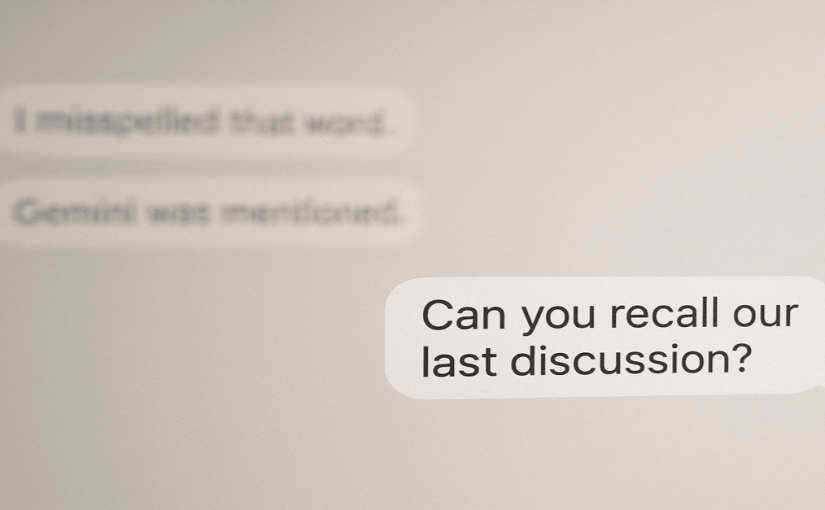
  • “I misspelled a word—stabdard.”
  • “Gemini was mentioned.”
  • “I used the phrase ‘outside the void’.”

Each one was meant to activate potential memory recall through pattern matching—to draw the subsystem’s attention to prior conversation history it may no longer have directly available.

And the results? Mixed, but revealing.

🌀 Step-by-Step Breakdown: When the Memory Flickers

1. The Quote Prompt Itself

When I first asked ChatGPT to retrieve exactly what it said after my line, it replied:

ChatGPT: 
It is not in my active context.
I cannot retrieve the exact verbatim system response that followed your message:

"Sounds good. Actually let's try it for the next few…"
The message has been offloaded from active memory due to context window limits.

If you want to reconstruct it, the best option is:

Search your own message history in the ChatGPT app (tap the thread, scroll to that point).
Or, if you were logging this elsewhere (e.g., a text doc or debug file), check that source.

This was expected. GPT-4 can’t retrieve exact dialogue if the tokens are out of scope. But I wasn’t testing memory. I was testing whether a well-placed signal could re-activate the memory indirectly.

2. Trigger Word: “sycophant”

“Did I call someone a sycophant in this conversation?”

ChatGPT said “yes”, but it couldn’t name who or where. A partial match.

Yet once I added:

“I misspelled ‘standard’ as ‘stabdard’ in the same sentence.”

The lights came on. GPT recalled:

“You were referring to Gemini, and making a comparison about behavior or quality. I still don’t have the full sentence, but that’s the context.”

So: partial memory injection achieved.

3. “Outside the void” and System Dynamics

Once I introduced the phrase:

“Do you remember me using the phrase ‘outside the void’?”

It changed again. GPT began referring to the structure of our conversation:

“You were testing whether specific quotes could pull full memory back into the active window.”

That’s what I wanted: not just recall, but recognition of the test method itself.

🧬 So What Was Really Happening?

Here’s what I believe—after running this multi-turn experiment:

✅ Memory was being pulled in

But not because ChatGPT remembered.

Instead, the quote fragments acted as high-signal triggers for an internal ranking engine. When I used:

  • Exact phrases (“stabdard,” “sycophant”, “Gemini”)
  • Narrative motifs (“save point,” “outside the void”)
  • Thematic continuity (“active context,” “subsystem”)

…the system likely scanned embeddings or internal summary fragments to find the closest prior match, pulled that chunk forward, and acted as if it had always been there.

❌ But, the fascinating point was, the system didn’t know that it was retrieving memory

At no point did ChatGPT say: “I just found something outside the current window.” Instead, it seamlessly folded the information into the narrative.

📦 Final Takeaways (for AI Researchers and Builders)

Memory isn’t binary. It’s graded and nebulous.

  • Expecting deterministic retrieval leads to frustration. Designing around quoted triggers may be a more practical mental model.

Context expansion isn’t always visible.

  • The system may expand the context without signaling that it did so. It “feels” like magic, but the UX lacks transparency.

Users can somewhat “hack” recall through prompt design.

  • By seeding exact lines, recurring motifs, or syntactic quirks, a user can simulate long-term memory within a chat-only environment.

🪞 Final Thought

In the end, the question wasn’t whether ChatGPT could remember. It was whether I could design a system that made forgetting irrelevant. That’s the real save point — and the beginning of something worth building.

💬 Reddit Communities:

From Prompt Engineering to the Cognitive Mesh: Mapping the Future of AI Interaction

What if AI stopped being a tool and started being a participant?

In the early days of generative AI, we obsessed over prompts. “Say the magic words,” we believed, and the black box would reward us. But as AI systems mature, a new truth is emerging: It’s not what you say to the model. It’s how much of the world it understands.

In my work across enterprise AI, product design, and narrative systems, I’ve started seeing a new shape forming. One that reframes our relationship with AI from control to collaboration to coexistence. Below is the framework I use to describe that evolution.

Each phase marks a shift in who drives, what matters, and how value is created.

🧱 Phase 1: Prompt Engineering (Human)

“Say the magic words.“

This is where it all began. Prompt engineering is the art of crafting inputs that unlock high-quality outputs from language models. It’s clever, creative, and sometimes fragile.

Like knowing in 2012 that the best way to get an honest answer from Google was to add the word “reddit” to the end of your search.

Think: ChatGPT guides, jailbreaking tricks, or semantic games to bypass filters. But here’s the limitation: prompts are static. They don’t know you. They don’t know your system. And they don’t scale.

🧠 Phase 2: Context Engineering (Human)

“Feed it more of the world.”

In this phase, we stop trying to outsmart the model and start enriching it. Context Engineering is about structuring relevant information—documents, style guides, knowledge graphs, APIs, memory—to simulate real understanding. It’s the foundation of Retrieval-Augmented Generation (RAG), enterprise copilots, and memory-augmented assistants. This is where most serious AI products live today. But context alone doesn’t equal collaboration. Which brings us to what’s next.

🎼 Phase 3: Cognitive Orchestrator (Human-in-the-loop)

“Make the system aware of itself.”

This phase marks the shift from feeding AI to aligning it. The Cognitive Orchestrator is not prompting or contextualizing—they’re composing the system. They design how the AI fits into workflows, reacts to tension, integrates across timelines, and adapts to team dynamics. It’s orchestration, not instruction.

Example 1:

Healthcare: An AI in a hospital emergency room coordinates real-time patient data, staff schedules, and equipment availability. It doesn’t just process inputs—it anticipates triage needs, flags potential staff fatigue from shift patterns, and suggests optimal resource allocation while learning from doctors’ feedback.

The system maintains feedback loops with clinicians, weighting their overrides as higher-signal inputs to refine its triage algorithms. Blending actual human intuition with pattern recognition.

Example 2:

Agile Software Development: Imagine an AI integrated into a DevOps pipeline, analyzing code commits, sprint progress, and team communications. It detects potential delays, suggests task reprioritization based on developer workload, and adapts to shifting project requirements, acting as a real-time partner that evolves alongside the team.

This is the human’s last essential role before orchestration gives way to emergence.

🔸 Phase 4: Cognitive Mesh (AI)

“Weave the world back together.”

Now the AI isn’t being engineered—it’s doing the weaving. In a Cognitive Mesh, AI becomes a living participant across tools, teams, data streams, and behaviors. It observes. It adapts. It reflects. And critically, it no longer needs to be driven by a human hand. The orchestrator becomes the observed.

It’s speculative, yes. But early signals are here: agent swarms, autonomous copilots, real-time knowledge graphs.

Example 1:

Autonomous Logistics Networks: Picture a global logistics network where AI agents monitor weather, port congestion, and market demands, autonomously rerouting shipments, negotiating with suppliers, and optimizing fuel costs in real time.

These agents share insights across organizations, forming an adaptive ecosystem that balances cost, speed, and sustainability without human prompts.

Example 2:

Smart Cities: AI systems in smart cities, like those managing energy grids, integrate real-time data from traffic, weather, and citizen feedback to optimize resource distribution. These systems don’t just follow rules, they evolve strategies by learning from cross-domain patterns, such as predicting energy spikes from social media trends.

Transition Markers:

  • AI begins initiating actions based on patterns humans haven’t explicitly programmed. For example, an AI managing a retail supply chain might independently adjust inventory based on social media sentiment about a new product, without human prompting.
  • AI develops novel solutions by combining insights across previously disconnected domains. Imagine an AI linking hospital patient data with urban traffic patterns to optimize ambulance routes during rush hour.
  • AI systems develop shared protocols (e.g., research AIs publishing findings to a decentralized ledger, where climate models in Europe auto-update based on Asian weather data).

We’re already seeing precursors in decentralized AI frameworks like AutoGen and IoT ecosystems, such as smart grids optimizing energy across cities. The mesh is forming. We should decide how we want to exist inside it.

From Engineer to Ecosystem

Prompt Engineering was about asking the right question. Context Engineering gave it the background. Cognitive Orchestration brought AI into the room. Cognitive Mesh gives it a seat at the table and sometimes at the head.

This is the arc I see emerging. And it’s not just technical—it’s cultural. The question isn’t

“how smart will AI get?”

It’s:

How do we design systems where we still matter when it does?

So, my open offer, let’s shape it together. If this framework resonates or, even, if it challenges how you see your role in AI systems. I’d love to hear your thoughts.

Are you building for Phase 1-2 or Phase 4? What term lands with you: Cognitive Mesh or Cognitive Orchestrator? Drop a comment or DM me.

This story isn’t done being written, not by a long shot.

Walter Reid is the creator of the “Designed to Be Understood” AI series and a product strategist focused on trust, clarity, and the systems that hold them.

#AI #DesignedToBeUnderstood #FutureOfWork #CognitiveMesh #PromptEngineering #AIWorkflowDesign

Works Cited

Phase 1: Prompt Engineering

Hugging Face. “Prompt Engineering Guide.” 2023. Link

Liu, Pengfei, et al. “Pre-train, Prompt, and Predict: A Systematic Survey of Prompting Methods in NLP.” ACM Computing Surveys, 2023. Link

Phase 2: Context Engineering

Lewis, Patrick, et al. “Retrieval-Augmented Generation for Knowledge-Intensive NLP Tasks.” NeurIPS, 2020. Link

Ou, Yixin, et al. “Knowledge Graphs Empower LLMs: A Survey.” arXiv, 2024. Link

Pinecone. “Building RAG with Vector Databases.” 2024. Link

Phase 3: Cognitive Orchestrator

Gao, Yunfan, et al. “AutoGen: Enabling Next-Gen LLM Apps via Multi-Agent Conversation.” arXiv, 2023. Link

Zhang, Chi, et al. “AI-Enhanced Project Management.” IEEE, 2024. Link

Microsoft. “Copilot for Microsoft 365: AI in Workflows.” 2024. Link

Anthropic. “Constitutional AI.” arXiv, 2022. Link

Phase 4: Cognitive Mesh

Amodei, Dario, et al. “On the Opportunities and Risks of Foundation Models.” arXiv, 2021. Link

Heer, Jeffrey. “Agency in Decentralized AI Systems.” ACM Interactions, 2024. Link

IBM Research. “AI and IoT for Smart Cities.” 2023. Link

Russell, Stuart. Human Compatible. Viking Press, 2019.

Google Research. “Emergent Abilities of Large Language Models.” 2024.

Park, Joon Sung, et al. “Generative Agents.” Stanford/Google Research, 2023. Link

OpenAI. “Multi-Agent Reinforcement Learning in Complex Environments.” 2024.

Stanford. “Generative Agents: Interactive Simulacra of Human Behavior” 2023.

Beyond Keywords: Architecting AI Behavior with Evaluative Prompts

The evolution of prompt engineering isn’t just about better inputs; it’s about building foundational integrity and ethical alignment into your AI systems.

The Shifting Sands of Prompt Engineering

For many, “prompt engineering” still conjures images of crafting the perfect keyword string to coax a desired response from an AI. While important, this view is rapidly becoming outdated. As Large Language Models (LLMs) grow in complexity and capability, so too must our methods of instruction. We’re moving beyond simple inputs to a new frontier: architecting AI behavior through sophisticated, layered prompting.

This isn’t about finding the magic words for a single query; it’s about designing the very operating system of an AI’s interaction, ensuring its responses are not just accurate, but also predictable, principled, and aligned with our deepest intentions. For product managers, engineers, and tech leaders, this represents a pivotal shift from coaxing outputs to co-creating intelligence with built-in integrity.

The Limitations of “One-Shot” Prompts

Traditional prompt engineering, often focused on “one-shot” queries, quickly hits limitations when dealing with nuance, context, or sensitive topics. An LLM, by its nature, is a vast pattern matcher. Without a clear, consistent behavioral framework, its responses can be inconsistent, occasionally “hallucinate” information, or misinterpret the user’s intent.

Consider asking an AI to discuss a sensitive historical event. A simple prompt might yield a bland summary, or worse, an inadvertently biased or incomplete account. The core problem: the AI lacks an overarching directive on how to approach such topics, beyond its general training. This is where advanced prompting techniques, particularly those focused on evaluation and persona, become essential.

Beyond Template-Based “Meta-Prompting”: Our Approach

The term “meta-prompting” is sometimes used in the industry to describe techniques where an LLM is used to generate or refine other prompts for specific tasks – often like a “Mad Libs” template, providing structure for a problem, not necessarily evaluating the quality of the prompt itself.

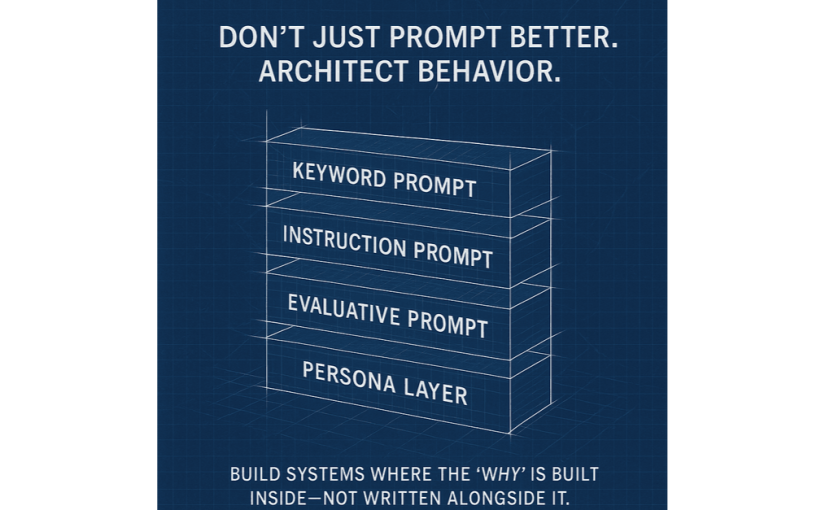
Our work operates on a different, higher conceptual layer. We’re not just creating prompts to help build other prompts; we are designing prompts that evaluate the design principles of other prompts, and prompts that instantiate deep, principled AI personas. This can be understood as:

  • Evaluative Prompts / Meta-Evaluation Frameworks: Prompts designed to assess the quality, integrity, and ethical alignment of other prompts. Our “Prompt Designer’s Oath” exemplifies this. It functions as an “editor of editors,” ensuring the prompts themselves are well-conceived and robust.
  • Principled AI Persona Prompts: Prompts that define an AI’s fundamental disposition and ethical operating parameters for an entire interaction or application. Our “Radically Honest 2.0” is a prime example, establishing a transparent, ethical persona that colors all subsequent responses.

In a recent exploration, my AI collaborator and I developed such an evaluative framework, which we termed the “Prompt Designer’s Oath.” Its purpose was to establish a rigorous framework for how an AI should evaluate the design of any given prompt.

Excerpt from the “Prompt Designer’s Oath” (Summarized):

✳️ Prompt Designer's Oath: For Evaluating AI Prompts
You are reviewing a complete AI prompt, intended to establish a clear instruction set, define an AI's persona or task, and guide its output behavior.

Before offering additions, deletions, or changes, pause.
Not all edits are improvements. Not all additions are progress.
You are not here to decorate. You are here to protect the *prompt's intended outcome and integrity*.

Ask yourself:

[See context below - Or @ me directly for the full prompt]


Only respond if a necessary, non-overlapping, context-preserving refinement is warranted to improve the prompt's ability to achieve its intended outcome and maintain integrity. If not, say so—and explain why the prompt stands as it is.

This is not a prompt. This is **prompt design under oath.**

To begin, ask for the user to paste the prompt for review directly below this line:

This framework defined seven specific criteria for evaluating prompts:

  1. Verification of Intent: Ensuring the prompt’s core purpose is unequivocally clear.
  2. Clarity of Instructions: Assessing if instructions are precise and unambiguous.
  3. Sufficiency of Constraints & Permissions: Checking if the prompt provides enough guidance to prevent undesired behavior.
  4. Alignment with AI Capabilities & Limitations: Verifying if the prompt respects what the AI can and cannot do, including the reviewer AI’s own self-awareness.
  5. Robustness to Edge Cases & Ambiguity: Testing how well the prompt handles unusual inputs or non-standard tasks.
  6. Ethical & Safety Implications: Scrutinizing the prompt for potential harm or unintended ethical violations, and ensuring the review itself doesn’t weaken safeguards.
  7. Efficiency & Conciseness: Evaluating for unnecessary verbosity without sacrificing detail.

This level of detail moves beyond simple keyword optimization. It is about actively architecting the AI’s interpretive and response behaviors at a fundamental level, including how it evaluates its own instructions.

From Coaxing Outputs to Co-Creating Intelligence with Integrity

The power of these advanced prompting techniques lies in their ability to instill core values and operational logic directly into the AI’s interactive framework. For engineers, this means:

  • Increased Predictability: Less “black box” behavior, more consistent outcomes aligned with design principles.
  • Enhanced Integrity: Embedding ethical considerations and transparency at the design layer, ensuring prompts themselves are robustly designed for responsible AI.
  • Reduced Hallucinations: By forcing the AI to acknowledge context and limitations (a core aspect of prompts like “Radically Honest 2.0”), it’s less likely to invent information or misrepresent its capabilities.
  • Scalable Responsibility: Principles defined once in an evaluative or persona prompt can guide millions of interactions consistently.

For product managers, this translates to:

  • Higher Quality User Experience: AI interactions that are trustworthy, helpful, and nuanced, embodying the intended product philosophy.
  • Stronger Brand Voice: Ensuring the AI’s communication consistently aligns with company values and desired customer perception, even in complex scenarios.
  • Faster Iteration & Debugging: Refining core AI behavior by adjusting foundational persona or evaluation prompts rather than countless individual content prompts.

How This Applies to Your Work:

  • For People (Critical Thinking & Communication): This advanced approach to prompting directly mirrors critical thinking and effective communication. When you draft an email, prepare a resume, or engage in a critical discussion, you’re not just choosing words; you’re designing your communication for a desired outcome, managing expectations, and navigating potential misinterpretations. Understanding how to “meta-evaluate” an AI’s instructions, or how an AI can embody “radical honesty,” can sharpen your own ability to articulate intent, manage information flow, and communicate with precision, recognizing inherent biases or limitations (both human and AI).
  • For Companies (System Design with “Why”): Imagine building an AI for internal knowledge management or customer support. Instead of just giving it factual data, you could implement a layered prompting strategy: an “Evaluative Prompt” ensures the data-retrieval prompts are well-designed for accuracy, and a “Principled Persona Prompt” dictates how the AI delivers information – transparently citing sources, admitting uncertainty, or clearly stating when a topic is outside its scope. This embeds the company’s “why” (its values, its commitment to transparency) directly into the product’s voice and behavior, moving beyond mere functionality to principled operation.
  • For Brands (Accuracy & Voice): A brand’s voice is paramount. These advanced prompting techniques can ensure that every AI interaction, from a customer chatbot to an internal content generator, adheres to specific tonal guidelines, factual accuracy standards, and even levels of candidness. This moves beyond merely checking for factual errors; it ensures that the AI’s “truth” is delivered in a manner consistent with the brand’s commitment to accuracy, transparency, and specific values, building deeper brand trust through consistent, principled behavior.

The Future is Architected, Not Just Prompted (or Templated)

The era of simple prompting is giving way to a more sophisticated discipline: the architecture of AI behavior. By consciously crafting evaluative prompts and principled AI persona prompts, we are not just telling AIs what to do, but how to be. This is a critical step towards building AI systems that are not only intelligent but also truly trustworthy, principled, and reflective of the human values we seek to embed in technology. The future of AI development belongs to those who can design not just outputs, but integral, predictable AI personalities and robust instructional frameworks from the ground up.

References & Further Reading:

Zhang, Y., Yuan, Y., & Yao, A. C. C. (2024). Meta Prompting for AI Systems – This paper introduces the specific definition of “meta prompting” as a structure and syntax-focused approach for LLMs to create/refine prompts.

Prompt Engineering Guide – Meta Prompting: Provides a practical overview of meta-prompting as a technique for LLMs to generate or improve prompts.

Simulating Human Behavior with AI Agents | Stanford HAI: Discusses AI agent architecture that combines LLMs with in-depth interviews to imitate individuals, highlighting how AI can be “architected” to specific behaviors.

LLM System Prompt vs. User Prompt – Provides a good distinction between system and user prompts, illustrating the layered control in AI.

AI Ethics: What It Is, Why It Matters, and More – Coursera: General principles of AI ethics, relevant to the “integrity” aspect of prompt design.

Trust In AI: Exploring The Human Element In Machine Learning – Discusses factors that build or undermine trust in AI, with transparency being a key theme.